
Generative artificial intelligence is transforming how people work, communicate, and create content, but its environmental impact extends far beyond electricity consumption. One of the most overlooked consequences of the AI revolution is its growing demand for water.
Every AI-generated response, image, and model training process relies on vast digital infrastructure that requires water for cooling data centers, generating electricity, and manufacturing advanced semiconductor chips. As the adoption of AI accelerates worldwide, so does its water footprint, raising important questions about sustainability and resource management.
In this article, we are going to take a look at how much water generative AI uses, along with the key sources of its water consumption and future projections for AI-related water demand through 2050.
How Much Water Does Generative AI Use?
Generative AI uses around 500 milliliters of water for a conversation of approximately 20 to 50 prompts. Generative AI uses water mainly because data centers that run AI models require cooling systems to prevent servers from overheating. Water is also indirectly consumed through the electricity needed to power these systems.
The exact amount of water used varies depending on factors such as the AI model, data center location, and cooling technology. However, studies suggest that the water footprint can be significant. Research from the University of California, Riverside, and the University of Texas at Arlington supports this estimate, showing that even short interactions with AI systems can contribute to measurable water usage.
Estimated Water Usage for Common AI Tasks

The amount of water consumed by an AI system varies depending on the complexity and length of the task being performed. While precise water usage per query is difficult to measure in real time, researchers have developed benchmark estimates based on data center cooling requirements and the water used to generate the electricity that powers AI infrastructure.
| AI Task | Estimated Water Usage |
| 100-word AI response | ~0.13 gallons |
| 250-word AI response | ~0.33 gallons |
| Summarizing an article | ~0.13 to 0.26 gallons |
| AI grammar check (500 words) | ~0.07 to 0.13 gallons |
| Standard chatbot conversation | ~0.13 gallons |
These estimates show that water use generally increases as AI tasks become more computationally demanding. Simple tasks, such as checking grammar or generating short answers, use relatively little water.
More complex tasks, including creating long-form content, require more computing power and therefore consume more water. Tasks like article summarization usually fall somewhere in between, depending on the length of the text being analyzed and the level of processing involved.
The Three Sources of AI’s Water Footprint
The water footprint of AI is not limited to what happens inside data centers. It is spread across multiple stages of the technology’s lifecycle from cooling servers and generating electricity to manufacturing the advanced chips that power AI systems.
1. Direct Data Center Cooling:
Data centers rely on water-based cooling systems, including evaporative cooling towers and air-handling units, to keep high-performance servers from overheating. In large hyperscale facilities, water use can reach up to 1.5 million liters per day when traditional cooling methods are used. This makes direct cooling one of the most visible sources of AI-related water consumption.
2. Indirect Electricity Generation:
AI systems require vast amounts of electricity, and much of this power is generated in thermal power plants that also consume water for steam production and cooling processes. On average, electricity generation in the United States withdraws about 43.8 liters of water per kilowatt-hour and consumes around 3.1 liters per kilowatt-hour. Because AI workloads are energy-intensive, this indirect source can account for roughly 60% of total AI-related water use.
3. Semiconductor Manufacturing:
A significant portion of AI’s water footprint is embedded in the production of advanced chips. Semiconductor fabrication requires ultrapure water to clean silicon wafers during manufacturing. Producing 1,000 gallons of ultrapure water can require 1,400 to 1,600 gallons of freshwater. At scale, a single fabrication facility may use up to 10 million gallons of water per day, while the global semiconductor industry consumes an estimated 210 trillion liters annually.
How Much Water Does a Single AI Query Use?
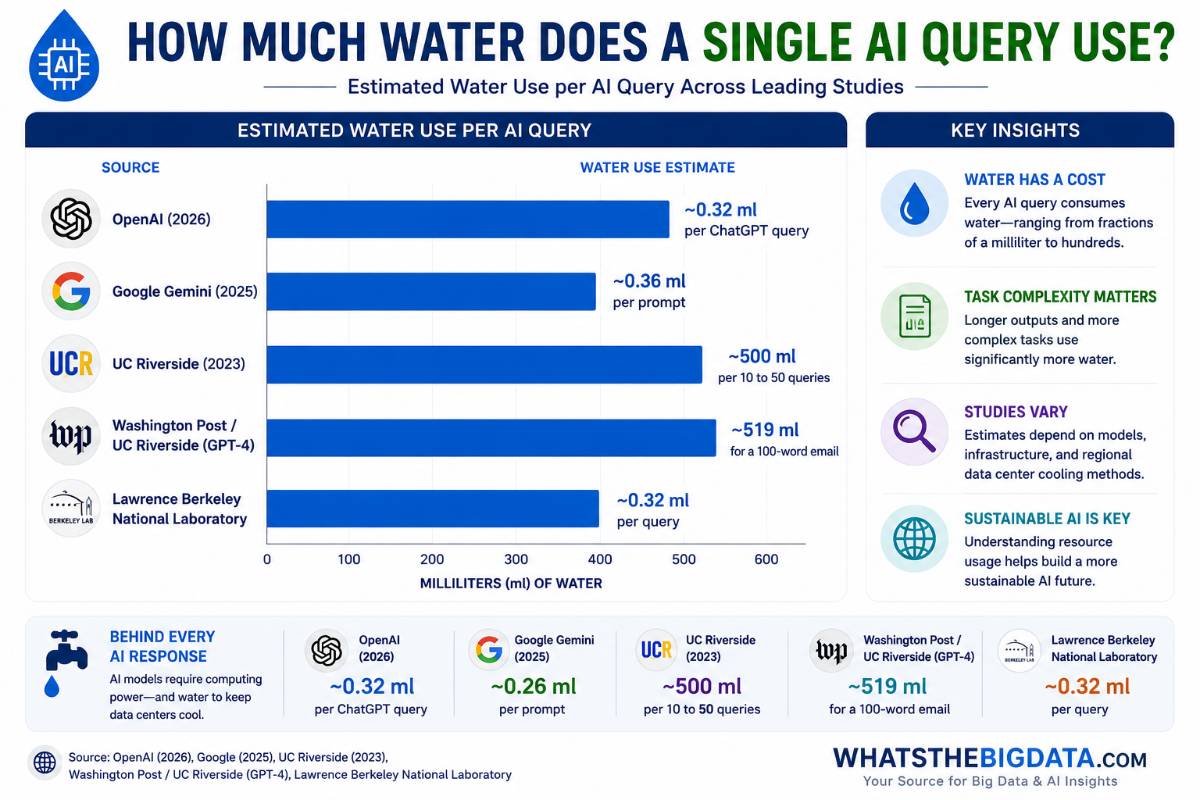
Estimating the water consumption of a single AI query is surprisingly complex. The answer depends on what is being measured, where the data center is located, and whether indirect water use from electricity generation is included. As a result, estimates vary significantly across studies and company disclosures.
| Source | Water Use Estimate |
| OpenAI (2026) | ~0.32 ml per ChatGPT query |
| Google Gemini (2025) | ~0.26 ml per prompt |
| UC Riverside (2023) | ~500 ml per 10 to 50 queries |
| Washington Post / UC Riverside (GPT-4) | ~519 ml for a 100-word email |
| Lawrence Berkeley National Laboratory | ~0.32 mL per query |
Source: Inc
Recent figures from AI companies suggest that individual prompts use only a fraction of a milliliter of water. In early 2026, OpenAI CEO Sam Altman stated that a typical ChatGPT query consumes approximately 0.32 milliliters of water, while Google reported that the median Gemini prompt uses around 0.26 milliliters, reflecting significant efficiency improvements in newer AI systems.
However, these estimates primarily measure the water used directly within data centers, such as cooling servers. Academic researchers have found that the total water footprint is much higher when indirect water use from electricity generation is included.
A widely cited study from the University of California, Riverside estimated that 10 to 50 ChatGPT queries can consume roughly 500 milliliters of water, equivalent to a standard bottle of water. Researchers also estimated that generating a 100-word email with GPT-4 requires about 519 milliliters of water.
Water Usage for AI Text Generation vs. AI Image Generation
The amount of water consumed by AI varies significantly depending on the type of content being generated. While text-based AI tasks such as answering questions or writing emails require relatively modest computing resources, image generation is far more resource-intensive. Creating images involves processing large amounts of visual data and performing substantially more calculations, which increases both energy consumption and the water needed for cooling and electricity production.
| Output Type | Estimated Water Use |
| AI Text Generation | Typically less than 1 mL of direct water use per query |
| AI Image Generation | ~15 to 60 ml per image |
| AI Video Generation | Potentially hundreds to thousands of times greater than text generation |
Research suggests that generating one image may consume approximately 15 to 60 milliliters of water, compared with fractions of a milliliter for a text query when only direct data-center water use is considered.
The gap widens further with advanced multimodal models. For example, generating an image can require up to 30 times more energy than producing a text response of similar complexity. At scale, the impact becomes even more pronounced: generating thousands of images consumes substantially more electricity and water than generating the same number of text outputs.
As AI usage increasingly expands beyond text into image, video, and multimedia creation, the environmental footprint of AI is likely to grow. While individual text queries have a relatively small water impact, visual AI applications place much greater demands on the infrastructure that powers them, making them a more significant contributor to AI-related water consumption.
Water Usage for AI Reasoning Models vs Standard AI Models
The water footprint of AI depends not only on the type of content being generated but also on the complexity of the model performing the task. While standard large language models are designed to generate responses quickly and efficiently, newer reasoning-focused models spend more time processing information, evaluating possibilities, and solving complex problems. This additional computation requires more energy and, in turn, increases water consumption.
| Model Type | Relative Water Impact |
| Standard AI Models | Baseline |
| AI Reasoning Models | Up to 100x higher |
Advanced reasoning models, such as OpenAI’s o3 and similar systems, can consume 7 to 40 watt-hours of energy per query, compared with roughly 0.3 watt-hours for a typical text-generation request. In some cases, this means a single reasoning query may require up to 100 times more computational resources than a standard AI response.
Because water consumption is closely linked to energy use and data-center cooling requirements, more intensive reasoning workloads generally have a larger water footprint. Tasks involving complex analysis, multi-step problem solving, coding, scientific research, or advanced decision-making require longer processing times and greater computational effort, increasing the resources needed to generate a response.
Water Consumption During AI Model Training

While individual AI queries consume relatively small amounts of water, training a large AI model is an entirely different scale of operation. Model training requires thousands of high-performance processors to run continuously for weeks or months, generating enormous amounts of heat that must be managed through cooling systems. The process also consumes vast amounts of electricity, adding substantial indirect water use through power generation.
| Models | Estimated Water Consumption |
| GPT-3 (direct data-center cooling) | ~700,000 liters |
| GPT-3 (including electricity-related water use) | ~5.4 million liters |
| GPT-3 training in a Microsoft Iowa data center | ~4.8 billion liters |
| GPT-3 trained in a less water-efficient location | Up to ~15 billion liters |
| GPT-4 training | ~600 million liters |
Source: UCRiversideNews
Research from the University of California, Riverside estimated that training GPT-3 directly consumed approximately 700,000 liters of freshwater for data-center cooling alone. When the water associated with electricity generation is included, thetotal footprint rises dramatically into the millions or even billions of liters depending on the location and energy mix of the data center.
One of the key findings from the research is that where a model is trained matters almost as much as the model itself. Data centers located in regions with different climates, cooling technologies, and electricity sources can have vastly different water footprints. Estimates suggest that training the same model in a less water-efficient environment could require several times more water than in a highly optimized facility.
The water demands continue to increase as AI models become larger and more computationally intensive. According to a 2026 report from the United Nations University Institute for Water, Environment and Health (UNU-INWEH), training GPT-4 may have consumed approximately 600 million liters of water. As frontier AI models grow in size and complexity, the resources required for training including both water and electricity are expected to rise significantly.
Global AI Water Consumption Trends
As the adoption of artificial intelligence has accelerated, so has its demand for water. From cooling data centers to generating electricity and manufacturing advanced chips, AI’s water footprint has grown rapidly alongside the expansion of cloud computing infrastructure. Although precise measurements remain difficult, available estimates show that AI-related water consumption has increased significantly over the past few years.
| Year | Estimate | Water Consumption |
| 2021 | Google U.S. data centers | ~12.7 billion liters |
| 2022 | Microsoft’s AI-related operations | ~1.7 billion liters |
| 2023 | U.S. data centers (direct water use) | ~66 billion liters (17.5 billion gallons) |
| 2024 | Global data center water consumption | ~560 billion liters |
| 2025 | Global AI systems | ~312 to 765 billion liters |
| 2025 | North American data centers | Nearly 1 trillion liters |
| 2025 | Global data centers (all workloads) | ~4.5 trillion liters |
In the early 2020s, water consumption by major technology companies was already reaching billions of liters annually. Google’s U.S. data centers used an estimated 12.7 billion liters of water in 2021, while Microsoft’s operations consumed approximately 1.7 billion liters in 2022. These figures reflected the growing demand for cloud services even before the widespread adoption of generative AI.
By 2023, data center water use had expanded considerably. U.S. data centers alone consumed an estimated 17.5 billion gallons (about 66 billion liters) of water directly for cooling and operational needs. Globally, total data center water consumption was estimated at around 560 billion liters, highlighting the increasing environmental demands of digital infrastructure.
The rapid rise of generative AI has further accelerated this trend. Research published in 2025 estimated that AI systems worldwide consumed between 312 billion and 765 billion liters of water annually.
At the upper end of the estimate, AI’s water use exceeded the world’s annual bottled water consumption. During the same period, North American data centers were estimated to use nearly 1 trillion liters of water, roughly equivalent to the annual water demand of a major metropolitan area such as New York City.
The global data centers consumed approximately 4.5 trillion liters of water and 448 terawatt-hours of electricity in 2025. AI workloads accounted for an estimated 15% to 20% of data center resource use, making artificial intelligence one of the fastest-growing contributors to data center water demand.
Future Projections: How Much Water Could AI Use by 2050?
The water footprint of AI is expected to grow rapidly over the coming decades as demand for generative AI, cloud computing, and advanced semiconductor manufacturing continues to increase.
While improvements in data center efficiency may reduce water use per computation, overall consumption is projected to rise sharply due to the scale of AI adoption worldwide. Several studies suggest that AI-related water demand could reach unprecedented levels within the next few years.
| Projection | Estimated Water Use |
| Global AI water withdrawals by 2027 | 4.2 to 6.6 billion m³ per year |
| U.S. data center water consumption by 2028 | 38 to 73 billion gallons per year |
| AI-related data center water use by 2028 (base case) | ~1.07 trillion liters per year |
| AI-related data center water use by 2028 (range) | 637 billion to 1.49 trillion liters per year |
| Alternative analyst estimates | More than 1 trillion liters annually by 2028 |
One of the most widely cited forecasts, published by researchers at the University of California, Riverside, estimates that global AI demand could account for 4.2 to 6.6 billion cubic meters of water withdrawals annually by 2027. This level of consumption would be comparable to the annual water withdrawals of several mid-sized countries combined.
Similarly, projections from Morgan Stanley suggest that water used for AI-related data center cooling and electricity generation could exceed 1 trillion liters per year by 2028, representing a dramatic increase from current levels. Depending on technological improvements and energy sources, estimates range from 637 billion to 1.49 trillion liters annually.
AI Water Consumption Projections for 2030
Researchers estimate that global data centers could consume approximately 9.3 trillion liters of water annually by 2030. According to projections from the United Nations University Institute for Water, Environment and Health (UNU-INWEH), AI-related water demand alone could approach the amount needed to meet the basic domestic water requirements of 1.3 billion people.
| 2030 Projection | Estimate |
| Global Data Center Water Consumption | ~9.3 trillion liters per year |
AI Water Demand Projections Through 2050
AI’s water footprint is expected to grow significantly over the coming decades, even as data centers become more efficient in their operations. According to a 2026 study by Xylem and Global Water Intelligence, AI-related water demand could increase by 129% by 2050, adding around 30 trillion liters of annual water demand worldwide.
| Water Consumption Projection (2050) | Estimate |
| Increase in AI-related water demand | +129% |
| Additional annual water demand | ~30 trillion liters |
| From power generation | ~54% |
| From semiconductor manufacturing | ~42% |
| From data center operations | ~4% |
Most of this growth will not come directly from data centers. Instead, it will be driven by the broader infrastructure needed to support AI. The study estimates that 54% of the additional water demand will result from expanded electricity generation, while 42% will come from increased semiconductor manufacturing required to produce advanced AI chips.
Direct data center operations are expected to account for only 4% of the increase. These projections highlight that the future water impact of AI extends far beyond data centers, encompassing the energy and manufacturing systems that make large-scale AI possible.
Water Use by Major Technology Companies
The rapid growth of artificial intelligence has placed increasing pressure on the world’s largest technology companies to expand their data center infrastructure. As AI workloads become more computationally intensive, water consumption has emerged as a growing sustainability concern.
Cooling AI servers, powering data centers, and supporting cloud infrastructure require substantial amounts of water, leading to significant increases in water use across the technology sector.
| Company | Latest Reported Water Use |
| 6.1 billion gallons (2024) | |
| Microsoft | 6.4 million m³ (latest reporting year) |
| Meta | 5,637 megaliters (2024) |
| Amazon | ~9 billion liters (2025) |
1. Google
Google’s water consumption has increased significantly alongside the expansion of its cloud and AI operations. The company’s data centers consumed around 6.1 billion gallons of water in 2024, compared with 4.3 billion gallons in 2021, representing a 42% increase in just three years. Overall water withdrawals reached 7.8 billion gallons, with roughly 78% of that water consumed rather than returned to its original source.
One of Google’s largest facilities, located in Council Bluffs, Iowa, withdrew an average of 3.9 million gallons of water per day and consumed approximately 2.8 million gallons daily.
2. Microsoft
Microsoft has experienced one of the sharpest increases in water use among major technology companies. Between 2020 and 2023, the company’s total water consumption increased by 87%, driven largely by investments in AI infrastructure and new data center capacity.
The company reported using approximately 6.4 million cubic meters of water in its most recent reporting year, representing a 34% year-over-year increase. In response to growing environmental concerns, Microsoft has begun deploying innovative cooling technologies, including data center designs that operate with little or no water consumption during normal operations.
3. Meta
Meta’s water consumption has also risen steadily as demand for its digital services and AI capabilities has grown. The company reported water use of 5,637 megaliters in 2024, up from 3,726 megaliters in 2020, representing an increase of 51% over four years.
This volume of water is roughly equivalent to the annual water needs of more than 13,000 households, illustrating the scale of resources required to support large-scale digital infrastructure.
4. Amazon
Amazon disclosed that its global data center operations consumed approximately 9 billion liters (2.5 billion gallons) of water in 2025. Unlike some of its competitors, Amazon does not regularly publish a single company-wide water consumption figure in its sustainability reports, instead reporting water-use metrics relative to data center power consumption and operational efficiency.
As the operator of one of the world’s largest cloud computing platforms, Amazon’s water footprint is expected to remain closely tied to the continued expansion of AI and cloud services.
Wrapping Up
Generative AI’s water footprint is becoming an increasingly important environmental issue as AI adoption continues to accelerate worldwide. Although a single AI query may consume only a small amount of water, the cumulative impact of billions of daily interactions, large-scale model training, data center cooling, electricity generation, and semiconductor manufacturing creates a substantial demand on global water resources.
As AI systems become more powerful and expand into energy-intensive applications such as image generation, video creation, and advanced reasoning, their water requirements are expected to grow significantly. While ongoing improvements in hardware efficiency and data center design may help reduce water consumption per computation, overall demand is projected to rise sharply due to the scale of AI deployment.
