
GPT stands for Generative Pre-Trained Transformer.
It’s the name of a powerful family of AI models that can understand and generate human-like text (and, in newer versions, images, audio, and more).
When you see ChatGPT, that’s a chat app built on top of these GPT models.
In this guide, we’ll break down:
- What “Generative”, “Pre-trained” and “Transformer” actually mean
- How GPT works (in simple language)
- The differences between GPT and ChatGPT
- The evolution from GPT-1 to GPT-5
- Real-world use cases, benefits, and limitations

What Does GPT Stand for in ChatGPT?
Let’s unpack the acronym word by word.
G – Generative
“Generative” means the model can produce new content:
Text, code, summaries, answers, or even images and audio (in newer models).
- It doesn’t just copy and paste from the internet.
- It predicts the next word (or token) repeatedly to build sentences and paragraphs that fit the context.
Think of it as a very advanced autocomplete that can write emails, essays, or even complete programs.
P – Pre-trained
“Pre-trained” means the model has been trained before you use it.
- It’s fed massive datasets: websites, books, articles, code, etc.
- During this phase, it learns patterns of language, grammar, facts, style, and relationships between words and concepts.
After this general pre-training, the model can be:
- Fine-tuned for specific tasks (like coding help or customer support)
- Aligned with human feedback so it behaves more safely and helpfully
T – Transformer
“Transformer” is the neural network architecture used by GPT models.
It was introduced in the landmark 2017 paper “Attention Is All You Need”, which replaced older RNN/CNN-based language models with a more parallel, efficient self-attention system.
Key idea:
Instead of reading text strictly left-to-right, a Transformer uses self-attention to look at all words in a sentence and decide which ones matter most for understanding meaning.
Example:
In the sentence “The bank by the river flooded after the storm,” the word “bank” is understood as a riverbank, not a financial bank, because of the surrounding context (“river”, “flooded”). Transformers excel at using this context.
What Is GPT in AI and Large Language Models?
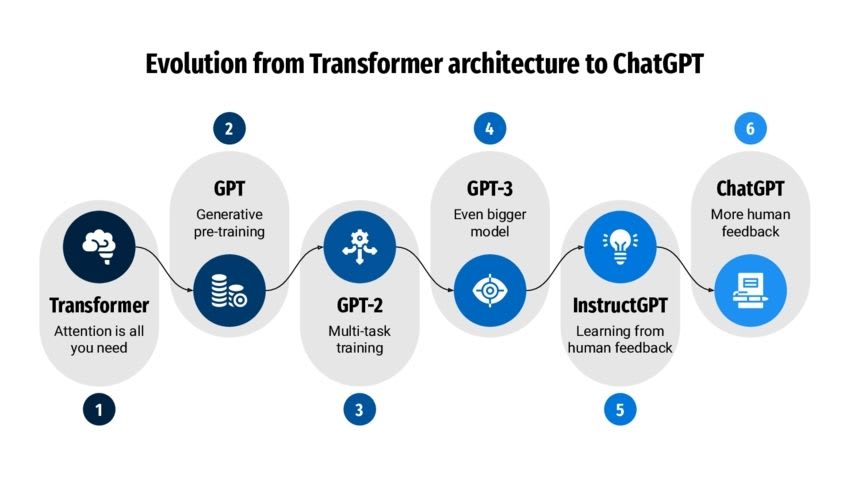
GPT is a type of large language model (LLM) based on the Transformer architecture. It’s trained on massive datasets so it can:
- Understand natural language prompts
- Generate human-like responses
- Summarize, translate, classify, or analyze text
- In newer versions, process images and audio as well
GPT models are considered foundation models: once trained, they can be adapted for many downstream tasks like chatbots, search, assistants, code generation, and domain-specific tools (finance, medicine, education, etc.).
GPT vs ChatGPT: What’s the Difference?
People often mix up GPT and ChatGPT, but they are not the same.
- GPT = the underlying model family (“engine”) – Generative Pre-Trained Transformer
- ChatGPT = a product / application that uses GPT models in a chat interface
ChatGPT originally ran on GPT-3.5 and later added GPT-4, GPT-4o, GPT-4.1, and now GPT-5 as OpenAI’s models evolved.
So when you ask:
“What does GPT stand for in ChatGPT?”
The answer is still Generative Pre-Trained Transformer, but used inside a chat product that adds:
- A conversational interface
- Safety layers and moderation
- Memory and tools (like web browsing, code execution, etc.)
How Does GPT Work? (Simple Explanation)
Here’s a beginner-friendly view of how GPT models operate.
1. Training Phase: Learning the Language
- Collect data
Text (and now also images/audio for multimodal models) from many sources. - Tokenize
Text is broken into small pieces called tokens (words, subwords, characters). - Self-supervised learning
The model is trained to predict the next token in a sequence over billions of examples. - Patterns emerge
By doing this at massive scale, the model implicitly learns:- Grammar and syntax
- Facts and world knowledge (up to its training cutoff)
- Reasoning patterns and style
2. Transformer & Attention (Core Mechanism)
Inside, GPT uses a decoder-only Transformer – multiple stacked layers of self-attention and feed-forward networks.
Self-attention lets the model:
- Look at every token in the input
- Decide which tokens are most relevant to each other
- Build a context-aware internal representation (embedding)
This is why GPT can handle long-range dependencies like:
“Alice gave the book to Bob because he asked for it.”
? “he” refers to Bob, not Alice.
3. Inference Phase: Generating Answers
When you type a prompt:
- The text is tokenized
- The Transformer layers compute internal representations using self-attention
- The model outputs a probability distribution for the next token
- It samples or selects the most likely token
- Repeat step 1–4 to generate a full sentence/paragraph
Settings like temperature and top-p control how creative or conservative the output is.
From GPT-1 to GPT-5: Evolution of the Models
GPT has gone through multiple generations, each bigger and more capable than the last.
GPT-1 (2018)
- ~117 million parameters
- Trained on BookCorpus (unpublished books)
- Proved that unsupervised pre-training + fine-tuning can beat many traditional NLP models
GPT-2 (2019)
- Up to 1.5 billion parameters
- Trained on ~8M web pages
- Generated surprisingly coherent long text, raising early concerns about fake news and misuse
- Initially released in stages due to those concerns
GPT-3 (2020)
- 175 billion parameters
- Showed strong few-shot and zero-shot performance
- Could:
- Write code
- Draft articles
- Answer questions with just a few examples in the prompt
GPT-3 provided the base for GPT-3.5, which powered early ChatGPT.
GPT-4 and GPT-4o (2023–2024)
OpenAI next introduced GPT-4, a stronger multimodal model (text + images), though exact parameter counts were not disclosed.
In May 2024, OpenAI released GPT-4o (“omni”):
- Multimodal: processes text, images, and audio
- More efficient and cheaper than previous GPT-4 variants
- Better performance in non-English languages and real-time conversations
GPT-4.1 and GPT-4.1 mini later improved context window size and coding performance, becoming widely available in ChatGPT for paid and then default users.
GPT-5 (2025)
In August 2025, OpenAI launched GPT-5, now the flagship model used in ChatGPT.
Key points:
- Multimodal: text, images, and video
- Significant gains in:
- Coding
- Math and logical reasoning
- Writing and editing
- Health and scientific tasks
- Uses a routed system (e.g., fast vs “thinking” modes) that decides when to:
- Answer quickly
- Spend more time reasoning deeply on hard queries
GPT-5 is also integrated into tools like Microsoft Copilot for Office, GitHub, and Azure, giving enterprise users advanced reasoning across documents, code, and workflows.
Quick Comparison Table: GPT-1 ? GPT-5
Note: Parameter counts are only public for GPT-1, GPT-2, and GPT-3. OpenAI has not disclosed parameter counts for GPT-4, GPT-4o, GPT-4.1, or GPT-5.
| Model | Year | Parameters (approx.) | Key Capabilities |
|---|---|---|---|
| GPT-1 | 2018 | 117M | Proof-of-concept transformer LLM, basic NLP tasks |
| GPT-2 | 2019 | 1.5B | Coherent long-form text, early concerns about misuse |
| GPT-3 | 2020 | 175B | Strong few-shot learning, code generation, broad NLP |
| GPT-3.5 | 2022 | Not disclosed | Powering early ChatGPT, improved stability & alignment |
| GPT-4 | 2023 | Not disclosed | Multimodal (text + image), strong exam performance |
| GPT-4o / 4.1 | 2024 | Not disclosed | Real-time audio, better non-English, larger context windows |
| GPT-5 | 2025 | Not disclosed | Multimodal + deeper reasoning, better coding, math, and long context |

What Does GPT Do in Practice?
Because GPT is a general-purpose generative model, it can be used in many ways:
1. Chatbots and Virtual Assistants
- Customer support
- FAQ bots
- Personal productivity assistants (scheduling, email drafts, reminders)
2. Content Creation
- Blog posts, outlines, and drafts
- Social media captions
- Product descriptions
- Marketing copy
3. Coding and Developer Tools
- Code generation and completion
- Explaining code snippets
- Refactoring and debugging
4. Translation and Localization
- Translating between many languages
- Helping with tone and style adaptation
5. Summarization and Research
- Summarizing long documents, reports, or meetings
- Extracting key points from research papers
- Assisting with literature reviews (with human verification)
6. Data & Text Analysis
- Sentiment analysis
- Classifying feedback, reviews, or survey responses
- Extracting entities (names, places, products)
Benefits of GPT
Why is GPT so widely used?
- Natural, human-like language
GPT models are trained on massive text corpora, so they generate responses that feel conversational and coherent. - Versatility
One model can handle many tasks: chat, code, translation, summarization, etc., just by changing the prompt. - Scalability & Adaptability
GPT can be:- Fine-tuned for industries (finance, law, healthcare)
- Integrated into apps (CRMs, IDEs, productivity suites)
- Boosts productivity & creativity
It reduces busywork, helps brainstorm ideas, and accelerates drafting content or code.
Limitations & Risks of GPT
Despite the hype, GPT has real limitations.
- Hallucinations (Inaccurate Facts)
GPT predicts plausible text, not guaranteed truth. It can confidently produce incorrect or outdated information. - Bias
Because it learns from human-generated data, it can reflect social and cultural biases present in that data. - Lack of true understanding
GPT manipulates patterns in data; it doesn’t “understand” like a human or have beliefs, emotions, or consciousness. - Security & Misuse
- Phishing and social engineering content
- Spam, misinformation, or deepfake-style text
Requires careful policy, monitoring, and guardrails.
- Opacity
Deep neural networks are often “black boxes”; it’s hard to trace exactly why a particular answer was generated.
Future of GPT Technology
Looking ahead, GPT research is moving in several directions:
- Better Reasoning & Tools
GPT-5 and successors focus on deeper reasoning, planning, and using external tools (search, code interpreters, databases). - More Multimodal Capabilities
Models like GPT-4o and GPT-5 handle text, images, audio, and video more smoothly, enabling richer assistants. - Customization & Fine-tuning
Easier ways for individuals and enterprises to build domain-specific GPTs with their own data. - Efficiency & Cost Reduction
New architectures and optimizations aim to reduce inference cost and energy usage, even as models get more capable. - Stronger Safety & Alignment
Research continues on:- Reducing harmful, biased, or deceptive outputs
- Making models more transparent and controllable
FAQs: What Does GPT Stand For?
1. What does GPT stand for?
GPT stands for Generative Pre-Trained Transformer – a type of AI model that learns from large amounts of text (and now images/audio) and can generate human-like content.
2. Is GPT the same as ChatGPT?
No. GPT is the family of underlying AI models, while ChatGPT is a chat application built on top of those models with a conversational interface, guardrails, and extra tools.
3. What does GPT do in ChatGPT?
In ChatGPT, GPT:
- Interprets your prompt
- Uses its learned patterns and the Transformer architecture to generate the next tokens
- Produces a human-like response, often combined with tools like browsing, code execution, or file analysis (depending on the version).
4. What is the latest GPT model?
As of late 2025, the latest major model from OpenAI is GPT-5, used in ChatGPT and integrated into platforms like Microsoft Copilot. It improves reasoning, coding, math, and multimodal understanding over earlier GPT-4 variants and GPT-4o.
5. Does GPT really “understand” what I say?
GPT is extremely good at modeling patterns in language and information, but it doesn’t “understand” in a human, conscious sense. It doesn’t have feelings, self-awareness, or intentions. It simply predicts the next best token based on its training and your prompt.
