

The Startup Unicorn Explosion (Infographic)
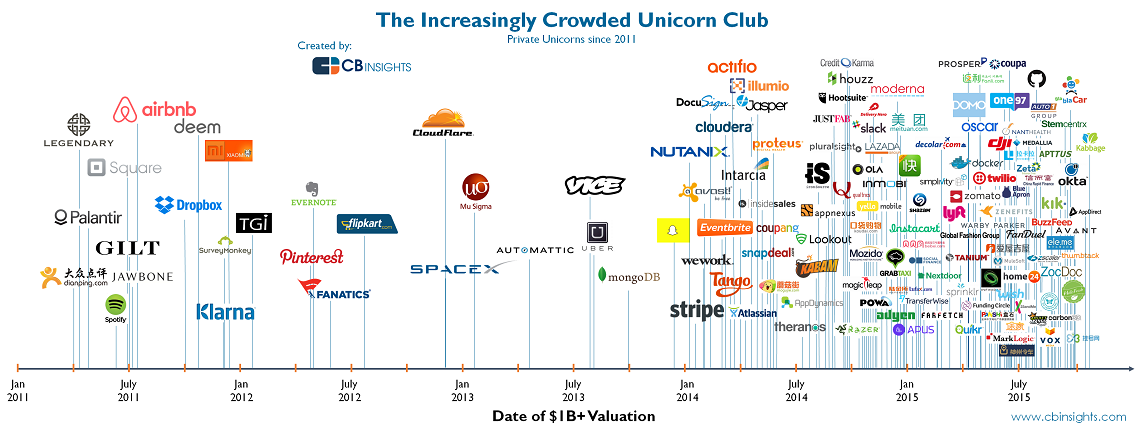
We looked at all still-private unicorns since 2011 and charted them based on when they first joined the unicorn club. While initially the chart shows unicorns being created at a relatively calm pace, the rhythm accelerates noticeably in late 2013 (right around the time Aileen Lee wrote her famous post coining the term unicorn in November 2013). Since then, there has been an explosion in unicorn creation, with over 60 new unicorns in 2015 alone.
See also The Unicorn List (updated in real-time)
Top Skills and Backgrounds of Data Scientists on LinkedIn
A new study of LinkedIn profiles by RJMetrics has found that the number of data scientists has doubled over the last 4 years . This reflects the increasing demand for sophisticated data analysis skills, combining computer programming with statistics, and the growth in the popularity of the term “data science” both in job openings and the words people use to describe their work on LinkedIn. At least 52% of all current 11,400 data scientists on LinkedIn have added that title to their profiles within the past 4 years.

In the chart above, the cumulative number of data scientists in any given year corresponds to the number of present-day data scientists who started their first job that year. We can safely assume that those who started their first jobs between 1995 and 2009 were not called then “data scientists,” but the data shows the cumulative growth in the number of professionals who have this title today.
Here are the other highlights of the study:
The high-tech industry (LinkedIn classification: Information Technology and Services industry, Internet and Computer Software industries) employs 44.9% of the professionals identified on LinkedIn as data scientists, followed by education (8.3%, probably employed mostly by universities), Banking and Financial Services (7.2%), and Marketing and Advertising (5.2%).
The top ten companies employing data scientists are Microsoft, Facebook, IBM, GlaxoSmithKline, Booz Allen Hamilton, Nielsen, GE, Apple, LinkedIn, and Teradata. Note that Google is not at the top ten, possibly because the data science Googlers on LinkedIn adhere to the title Google bestows on them: quantitative analyst.

Both Microsoft and Facebook, according to RJMetrics’ analysis, appear to be on a hiring spree, accelerating their data scientist recruiting during the 2014 calendar year by at least 151% and 39%, respectively, when compared to 2013. But given the scarcity of experienced data scientists, it’s a revolving door, with Microsoft also losing the largest number of data scientists over that period.
So how do you become one of these unicorn data scientists, commanding annual salaries of $200,000 plus? The study provides fresh data on the skills and background of data scientists.
RJMetrics analyzed 254,000 skill records of the data scientists on LinkedIn and ranked each skill by the number of people listing it on their profile. In addition to the catch-all categories of “data analysis,” “data mining,” and “analytics,” the top skills are R, Python, machine learning, statistics, SQL, MATLAB, Java, statistical modeling, and C++. Hadoop (20.9%) is at the bottom of the top 20, as a specific skill, behind SAS (22.78%).

An analysis of skills by job levels revealed that chief data scientists appear to be less technical on average: Only 27% and 26% listed Python and R, respectively, compared to 52% and 53% of junior data scientists, along with 38% and 43% of senior practitioners. Those at higher level jobs may not need to emphasize their technical skills or may not need them in positions where management experience and knowledge of a business domain are valued more than technical proficiency.
Over 79% of data scientists listing their education have earned a graduate degree, with 38% of all data scientists who had an education record earning a PhD, and close to 42% listing a Master’s degree as the highest degree attained.
Computer Science is the dominant field of study among data scientists, followed by business administration/management, statistics, mathematics, and physics. Only 4.6% of data scientists list “machine learning/data science” as their graduate degree, a number that will probably increase in coming years due to the proliferation of new Master in Data Science programs, supplanting the older Master in Analytics programs.

Note that RJMetrics included in their sample only data scientists associated with specific companies, assuming that those listing “data scientist” in their profile without an association with an actual company may only have aspirations about a career in data science, but not actual experience. They analyzed 60,200 records of professional experiences, 27,700 records of education, and 254,600 records of skills, and information about 6,200 unique companies that employed self-identified data scientists as of June 1, 2015.
For other recent studies of the skills and salaries of data scientists see here and here.
Posted in Data Science
Tagged backgrounds of data scientists, jobs, LinkedIn, skills of data scientists
Leave a comment
Hunting Unicorns and Rapidly Becoming the Master of the Startup Universe

Anand Sanwal, co-founder and CEO, CB Insights
CB Insights is riding the Unicorn Boom, doubling its headcount since the beginning of the year, propelled by its unique database of companies and investors and everything there is to know about them. The frequency of “according to CB Insights” appearing in a wide range of media outlets has gone up dramatically this year. The fast-growing subscriber list for its engaging newsletter, bursting with visually-appealing data nuggets and topical analysis, is now at more than 100,000. Recently, it has supplied the New York Times with a list of the “50 Companies That May Be the Next Start-Up Unicorns.”
This master of the startup universe got its start as Chubby Brain. “In our early days we were talking to an investment bank and they said they really liked our product but they will never buy something called Chubby Brain,” recalls Anand Sanwal, CB Insights’ co-founder and CEO. “At that moment we understood we needed to lose some of our edgy internet entrepreneur desire, given the market we were going after,” he adds.
The market they were going after consisted of all the people that need to understand the health of private companies. Doing M&As for American Express and managing, among other things, investments in companies trying to disrupt AmEx, Sanwal found out how difficult it was to use traditional information providers such as Dow Jones and Thomson (“their products, in one word, are terrible,” he says). To find out what’s going on with startups and other private companies, people were spending a lot of time manually gathering data by calling investors and VCs. Besides, the scope of this data collection was severely limited by the fact that private companies do their best to keep their financial performance private.
The answer to this need was in the explosion of publicly available data on the Web. “Better understanding private companies by using public information was the germ of the idea for CB Insights,” says Sanwal.
So a new digital business was born. CB Insights uses big data tools to automate the data collection, crawling about 100,000 sources daily, and big data algorithms to analyze the data about investors, companies, and industries. Most important, it identifies and tracks the publicly available signals that serve as good indicators of the health of private companies, e.g., hiring statistics from job boards, news and sentiment about the news, and information about new partners and customers. “I don’t think any of these [signals] is going to be independently a smoking gun,” says Sanwal. “We build this mosaic of a private company that’s instructive in understanding its health.” Doing it since 2009, CB Insights has amassed a large historical record that allows it to pinpoint which signals are strong (serving as valid indicators of a company’s success or failure) and which are weak.
Ironically for a startup that started up by providing recommendations to other entrepreneurs about the best funding sources for their startups, the founders of CB Insights did not seek angel or VC investment. Instead, they applied for a grant from the Small Business Innovation Research (SBIR) program of the National Science Foundation (NSF). The timing was right, as banks stopped lending to small businesses after the financial crisis. “Banks think about private companies as one monolithic entity,” says Sanwal, “and when times are tough they see all small businesses as a risk. Our thesis was—can we give lenders data that will help them make better decisions.”
They got an initial $150,000 grant to prove their thesis. When they did, they received a $500,000 grant, and when they started generating revenues, an additional $500,000, for a total of $1.15 million. “I don’t think we needed the NSF money from a survival perspective,” says Sanwal, “but it let us pursue some of the more moonshot ideas.”
In addition to this unusual funding mechanism, CB Insights is also quite unique in this Unicorn Boom era in that it has been revenue-funded from the beginning. “We’ve been very disciplined, always making more revenues than we spend every month,” says Sanwal. That’s a lesson he learned working for Kozmo.com, one of the poster boys of the dot-com bubble which shut down after raising about $250 million. “I saw the perils of growth at all costs,” he says.
On the flip side, Sanwal probably also saw the benefits of free publicity, generated by the media’s obsession with dot-com startups. The SBIR grants helped in marketing the company as “a National Science Foundation-backed big data company” to potential customers and employees, but CB Insights needed more than the prestige of government-backed research to reach its targeted audience.
“We had zero marketing dollars,” says Sanwal, “and unlike Dow Jones or Thomson we could not take [prospects] to a dinner or a Yankees game.” Instead, their “weapon of choice” was their excellence at Excel. They started building a “content marketing engine,” providing potential customers—and the media—with a taste of what can be done with their data and analysis, via a newsletter and on their research blog. This marketing effort has showcased their data visualization skills, knack for knowing what will be quoted in the media, and an engaging combination of far-from-suppressed edgy humor, “data geeks” passion, and maverick attitude (Sanwal signs all newsletters with “I love you” or, most recently, with “even if you never say it back, I still love you”).
The Unicorn Boom has provided a lot of opportunities for CB Insights to demonstrate their predictive analytics skills and get lots of free publicity, although hunting unicorns is a very insignificant part of the business. But, by popular demand, Sanwal has been happy to offer an opinion in the press and public speaking engagements regarding the perennial question—are we in a bubble? No, he says, ”the mechanism that’s going to force valuations down isn’t there as the public markets are closed to private companies right now. If companies start to IPO that have no business going public, then we will start to worry. A unicorn might fail and this will generate headlines but it will not cause any systemic risk to anybody. Right now, it’s only a private market euphoria, but no doubt it’s a little crazy.” (In this presentation, Sanwal explains in more detail why there is no bubble right now).
Sanwal says he has always wanted to be an entrepreneur: “I grew up in a family that was entrepreneurial. My father is a chemical engineer and started his own chemical manufacturing firm long time ago. I always wanted to be my own boss.” Sanwal got at Wharton a chemical engineering degree and a finance/accounting degree, so I asked him what did his father think about him not pursuing an engineering career. “I think he knew he is a much better engineer than I’ll ever be and that the world is a much safer place because I’m not engineer,” Sanwal answered.
Like other successful entrepreneurs, Sanwal has a larger vision, going beyond the specific business opportunity he has spotted. Providing lenders, investors, and others a risk assessment tool akin to a FICO score for private companies, CB Insights makes private markets work faster, enabling faster decision-making. Correcting the inefficiencies he discovered in the market for information on private companies, leads to smoothing the inefficiencies in a variety of economic decisions, activities, and endeavors.
That vision was behind the development of a predictive analytics platform on top of high-quality database, serving as the foundation from which to launch a variety of applications or services targeted at specific audiences and needs. In addition to a subscription-based access to its database, CB Insights has offered so far applications and tools for assessing the health of private companies and investors, mapping the links between investors and companies, tracking valuation and valuation multiples data, monitoring the health and growth potential of markets, and industry analytics.
About a month ago, the company launched CB Insights for Sales, “helping sales teams fill the top of their funnel with more prospects,” says Sanwal. It is targeted at companies selling “high-value products, $10,000 and above,” and corrects yet another inefficiency—the business-to-business selling process which is “hopelessly antiquated.” Salespeople need not only new leads, but also to nurture their prospects. CB Insights’ database—which Sanwal argues is a competitive differentiator in the crowded sales analytics market—alerts them to news about the prospect which provide them with a reason to call. A company signing up for CB Insights for Sales uploads a list of their existing clients, which helps the application provide a similar list of companies to target. This is a big step for CB Insights towards customizing their database for the need of a specific customer.
Other recent and potential applications include recommending the likely acquirers of a private company, identifying the industries and markets that are hot, indicating for accounts receivables departments when they should tighten up credit terms for specific companies, and identifying for recruiters companies that are not doing too well so they can poach their talent. The long-term goal is to provide “a predictive analytics API that other people can pull into their own use cases and platforms,” says Sanwal.
CB Insights aims to be “the Bloomberg for private companies,” Sanwal tells his public audiences. But it’s more than that. “Our mantra internally is that probability trumps punditry,” he says. “We want to take on all of those people who make bold prognostications of where the world is going but they completely pull it out of [thin air]. We want to use data to inform the conversation about what’s next.”
Update: On November 9, 2015, CB Insights announced it has raised a $10 million Series A and provided details regarding its business metrics.
Originally published on Forbes.com
Posted in Misc
Leave a comment
45% of work activities can be automated including those performed by highest-paid occupations

…our research suggests that as many as 45 percent of the activities individuals are paid to perform can be automated by adapting currently demonstrated technologies.4 In the United States, these activities represent about $2 trillion in annual wages. Although we often think of automation primarily affecting low-skill, low-wage roles, we discovered that even the highest-paid occupations in the economy, such as financial managers, physicians, and senior executives, including CEOs, have a significant amount of activity that can be automated…
…fewer than 5 percent of occupations can be entirely automated using current technology. However, about 60 percent of occupations could have 30 percent or more of their constituent activities automated. In other words, automation is likely to change the vast majority of occupations—at least to some degree—which will necessitate significant job redefinition and a transformation of business processes. Mortgage-loan officers, for instance, will spend much less time inspecting and processing rote paperwork and more time reviewing exceptions, which will allow them to process more loans and spend more time advising clients. Similarly, in a world where the diagnosis of many health issues could be effectively automated, an emergency room could combine triage and diagnosis and leave doctors to focus on the most acute or unusual cases while improving accuracy for the most common issues.
As roles and processes get redefined, the economic benefits of automation will extend far beyond labor savings. Particularly in the highest-paid occupations, machines can augment human capabilities to a high degree, and amplify the value of expertise by increasing an individual’s work capacity and freeing the employee to focus on work of higher value. Lawyers are already using text-mining techniques to read through the thousands of documents collected during discovery, and to identify the most relevant ones for deeper review by legal staff. Similarly, sales organizations could use automation to generate leads and identify more likely opportunities for cross-selling and upselling, increasing the time frontline salespeople have for interacting with customers and improving the quality of offers…
Our work to date suggests that a significant percentage of the activities performed by even those in the highest-paid occupations (for example, financial planners, physicians, and senior executives) can be automated by adapting current technology.7 For example, we estimate that activities consuming more than 20 percent of a CEO’s working time could be automated using current technologies. These include analyzing reports and data to inform operational decisions, preparing staff assignments, and reviewing status reports. Conversely, there are many lower-wage occupations such as home health aides, landscapers, and maintenance workers, where only a very small percentage of activities could be automated with technology available today [see chart above].
Google: Machine Learning and Deep Neural Networks Explained (Video)
[youtube https://www.youtube.com/watch?v=bHvf7Tagt18?rel=0]
*Greg and Chris did an AMA on Friday, September 25th to answer people’s deep learning questions. Check out their answers here: https://goo.gl/jpbMy9
*To read more about machine learning, neural nets, and the like – check out the Google Research blog:http://googleresearch.blogspot.com/ and Chris’s blog: http://colah.github.io/
Posted in Artificial Intelligence, Machine Learning
Tagged deep learning, neural networks
Leave a comment

68% of Americans have smartphones, 45% have tablet computers, other devices not growing

Today, 68% of U.S. adults have a smartphone, up from 35% in 2011, and tablet computer ownership has edged up to 45% among adults, according to newly released survey data from the Pew Research Center. Smartphone ownership is nearing the saturation point with some groups: 86% of those ages 18-29 have a smartphone, as do 83% of those ages 30-49 and 87% of those living in households earning $75,000 and up annually.
The Economist’s Data Editor on Data Fetishism

Ken Cukier
“We fetishize data, we think that data is the answer. It’s far from the truth. In fact, it’s ridiculous, because the data is only a simulacrum of reality in the same way that a map is not a territory. And so while we need to use information and data to make decisions as we need to do, the data is always unfaithful, always unreliable, it always misleads, and you have to torture it until it confesses”–Kenneth Cukier, Data Editor, The Economist
Source: Economist Radio, “Arthur Miller and Modern-Day Witch-Hunts”
FinTech Startups:The Landscape of Blockchain Companies in Financial Services

Source: Startup Management
HT: Leaders in Pharmaceutical Business Intelligence
Bitcoin fanatics are enthralled by the libertarian ideal of a pure, digital currency beyond the reach of any central bank. The real innovation is not the digital coins themselves, but the trust machine that mints them—and which promises much more besides.
Whatever you think of the cryptocurrency, the “blockchain” is a trust machine that may yet take its place alongside double-entry book-keeping and the limited-liability company as a way of oiling the wheels of commerce.