Today, startups are in high demand across the world, as various individuals with good degrees and experience are launching their own startups with unique innovation to create a name for themselves. However, startups have numerous vulnerable risks which can cause your startup to fail in the market.
The average startup failure rate is currently 90% based on the latest data. While 10% of newly launched startups are likely to not survive the industry within its first year.
In this article, we are going to dive into the top startups failure rate statistics (2024) to help uncover the various trends, reasons, patterns, etc that can help entrepreneurs and startup owners be alert and achieve success in their business.
Top Startup Failure Rate Statistics (2024)
- The Startup Failure Rate is currently 90%.
- 10% of the newly launched startup witnessed failure within its first year.
- Poor Product market fit is considered as the most common reason behind startups failing.
- 34% of small businesses that are unsuccessful are due to poor product-market fit.
- The success rate of startups is only 10% to 20% in the long run.
- 45% of startups are unable to survive the fifth year.
- Insufficient funding is the second most common reason behind 29% of startups failing.
- Cash flow was reported as one of the major problems that caused failure for 82% of businesses in 2023.
- 22% of failing startups are caused due to wrong marketing strategies.
- 75% of business witness failure during the first 15 years.
Startup Failure Rates (1 to 15 years)
The startup industry is a challenging place and it takes a large amount of effort and dedication to establish your business. Apparently, 10% of newly launched startups aren’t able to survive its first year itself. The success-rate of first-time startup entrepreneurs is only 18%.
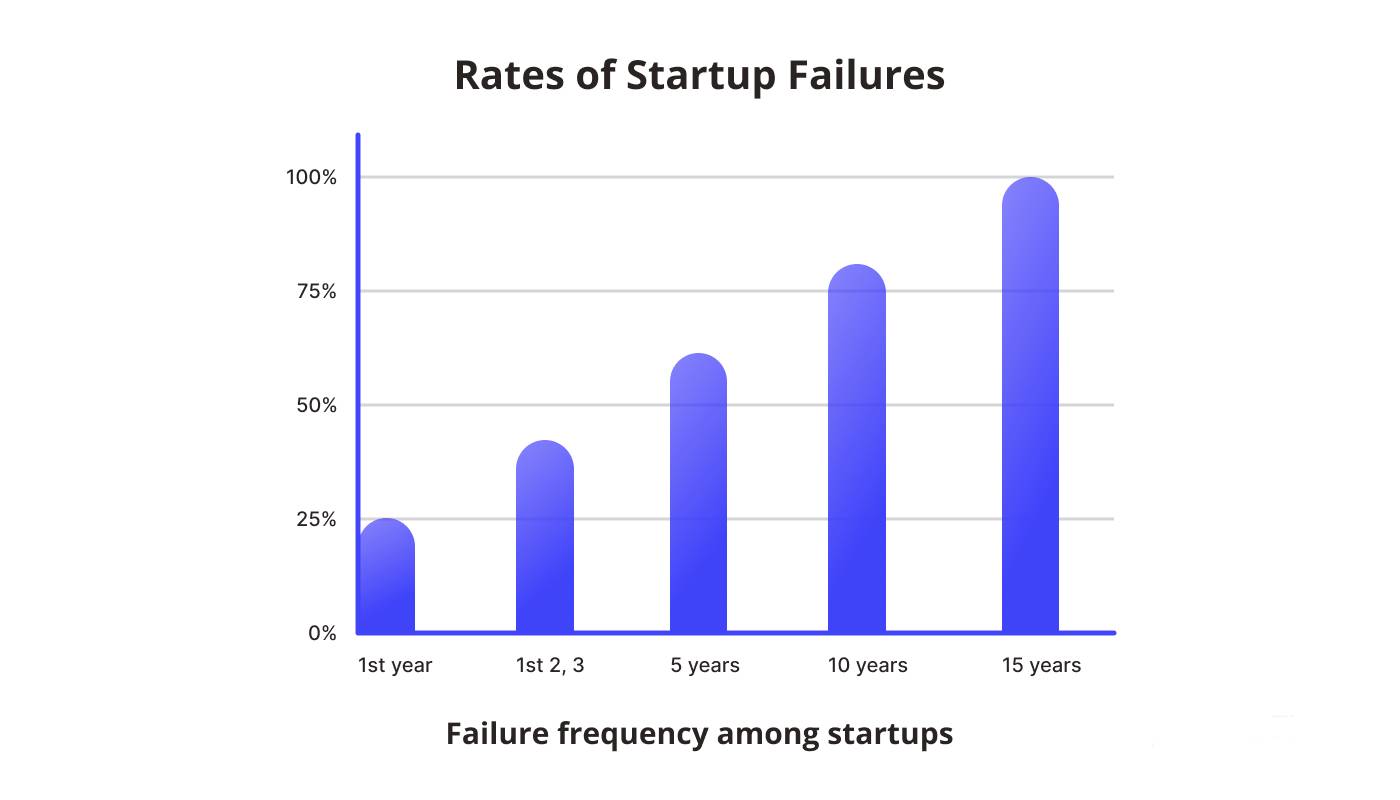
According to a report by the United States Bureau of Labor Statistics, the startup failure rate will keep on growing over time. When talking about the long run in the startup category, only 10% of businesses manage to survive the industry while 90% eventually fail.
Here we have mentioned a table showcasing the startup failure rates over the years:
| Year | Failure Rate |
| First year | 10% |
| First two years | 20% |
| Within five years | 45% |
| Within ten years | 65% |
| Within 15 years | 75% |
Top Reasons Behind Startup Failure
There can be numerous reasons behind a failure of a startup since the number of startups fails is 90% itself. However, the common reasons noticed behind a startup failure is Poor product-market fit which has caused 34% of startups to fail.
Followed by wrong marketing strategies landing as the second most common reason with 22% of startup failure. It’s extremely important to invest in good marketing strategies and connect with your target audience for your business to grow and present your product as a solution and towards the issues faced by the consumers. Not having a well-executed marketing strategy can cause your business to fail.
Below we have mentioned a table highlighting the Top 7 reasons behind startup failure to provide you a closure behind such high number of failures across all industries:
| Top Reason | Startup Failure Percentages |
| Poor Product-Market Fit | 34% |
| Wrong Marketing Strategies | 22% |
| Team or Human Resources issues | 18% |
| Cash flow problems | 16% |
| Tech-related issues | 6% |
| Suboptimal operations | 2% |
| Legal issues | 2% |
Cash flow issues are one of the leading concerns faced by the majority of entrepreneurs in the United States which has played a significant role in the failure of numerous businesses in the US. Entrepreneurs who start their business without sufficient funding, product or service prices which aren’t market-related can end up being a failing startup.
At times, lack of experience or not having essential qualifications can also lead to startup failure. Since, having proper knowledge and experience in the industry is extremely vital for the success of the startup. Therefore, an entrepreneur should first focus towards learning and become an expert in the industry before starting their own business.
Business Failure Rates by Industry

The business failure rates across all industries are pretty similar. Surprisingly, the information industry has the highest failure rate at 63%. Since the information industry contains relatively low barriers when it comes to entry and also has a massive portion of high-risk startups which plays a significant role in its failure rate.
Transportation and utilities is ranked as the second business with highest failure rates at 55%. Below we have mentioned a table showcasing leading business failure rates by industry:
| Industry | Failure Rate |
| Information | 63% |
| Transportation and utilities | 55% |
| Manufacturing | 51% |
| Construction | 53% |
| Retail | 53% |
| Mining | 49% |
| Wholesale | 46% |
| Services | 45% |
| Education and health | 44% |
| Agriculture | 44% |
| Finance insurance & Real estate | 42% |
Startup Success Rates
On a Average, the success rate for startups is only 10% to 20% in terms of long run. Although there are several factors that play a significant role in terms of determining the success potential of a startup. According to Small Business Trends, most entrepreneurs or owners of successful startups have good qualifications and experience in relevant fields which has contributed to the success potential of their startup.
Another major factor that contributes to the success of a business long-term success is the strong marketing strategies and ability to fit the needs and requirements of their target audience and consumers. Here we have mentioned some key statistics of top small business success rates to help you get a better idea about the startup success rate:
Top Statistics of Startup Success Rates
- There is only 18% success potential of first-time small business entrepreneurs or owners.
- Business owners who have previously launched a successful startup have a higher chance (30%) of gaining success in their new venture.
- Surprisingly, previously failed business owners have a 20% startup success rate.
Startup Failure Rate By Industry And Sector
The Failure Rate of Startups are relatively different depending on various industries and sectors. For example the failure rate of Construction startups likely to fail in the first year is 20%, similarly the failure rate of technology startups is 63% in the first five years.
Below we have mentioned statistics regarding the failure rates of different industries and sector to provide a in-depth knowledge on the failure chances of startups in different businesses:
Statistics for Construction Startups
Construction startups is currently one of the most popular businesses worldwide and usually the leaders tend to witness increasing success in this industry. Such startups work towards creation and delivering unique and useful solutions to save construction duration and cost while improving the overall quality and providing compliance with beneficial standards. Regardless of the massive popularity of the construction solution, the failure rate of this industry is still relatively high in North America.
Construction Startup Statistics
- 20% of the construction startups are likely to fail within its first year.
- A construction business has 36.6% of chances of surviving over 5 years in the industry.
- AI technology is likely to enhance the profits of construction industries by 71%.
- About 2 out of 3 construction startups are likely to fail within 10 years.
Fintech Startups Statistics
Startups in the Financial technology industry mergers technology along with innovation to generate various conventional solutions under the financial domain. The operations of successful fintech startups usually base their operations on iteration and continuous user testing. The organizations that are supported are accounting, banking, and various other useful industries.
In 2011 the global fintech investments was $1.8 billion and by 2018 it reached $30.8 billion. In 2022, the Global fintech industry was worthed $310 billion. The startup failure rate in Fintech is relatively lower compared to other industries. Currently, the fintech startup failure rate is 75%. As of now, there are over 8,775 fintech startups in the US itself.
Statistics for Technology Startups
Technology startups have massive demand in the United States and the profitability of tech giants usually attracts a massive number of entrants. Although, this industry also contains various pitfalls and the failure rate of a tech startup is much higher compared to the other industry. Some of the well-known technology businesses in the United States are Facebook, Apple, and Google.
- Apparently, 63% of tech startups are likely to fail within the first five years.
- 20 tech companies launched in the US are likely to generate $100 in its revenues.
- The average of a tech startup entrepreneur is 39 in the US.
- On an average a tech business pays $102,000 every year to its employees.
Statistics for Real Estate Startups
Real Estate startups is another one of the most popular industries in the US that has a significant contribution towards the GDP. This industry comprises conventional real estate property technology and services. But in comparison to the technology industry the failure rate of Real Estate startups is higher.
Real Estate Startup Statistics
- The failure rate of Estate startups within the next four years is 48%.
- 31% of US-based commercial investors are likely to invest in proptech businesses.
- In 2019, Real estate business generated $1.9 billion in the US.
Wrapping Up
Regardless of massive demands of Startups in the United States only 1 in every 10 startups are likely to witness success in the long run. Surprisingly the average Startup Failure Rate today is 90%. While almost 10% of the newly launched startups aren’t even able to survive the first year in business. Above we have mentioned some of the most valuable statistics that help you understand the chances of a startup failing in the future by industry along with various common reasons that can cause startup failure and needs to be looked after by business owners.