SAS CTO on Big Data and Big Compute

“One of my biggest challenges,” Keith Collins told me recently, “is helping SAS understand how to communicate to IT organizations. We present workloads which look odd and different. IT does not know how to have an SLA (Service Level Agreement) around them.  We take all of the compute and I/O capacity that they can give us.”

SAS, the largest independent vendor in the business intelligence market, used to be a prime example of “shadow IT,” the purchasing of information technology tools by business users without the knowledge and approval of the central IT organization. But this is changing in the era of big data. The collection and analysis of data are becoming a very large part of many business activities and the IT organization is asked to provide support, even leadership, in tying together these disparate efforts.

Collins is SVP and CTO at SAS, where he has spent almost 30 years, helping the company grow with the market through a number of phases (and buzzwords)—statistical analysis, decision-support, data mining, knowledge and risk management, business intelligence, and business analytics.  Now SAS is helping its customers, including CIOs and their IT teams, address the challenges of big data. Collins has seen this movie before: “People are all hyped up about Hadoop.  But what is it, really? It is big and wide record sizes, big block sizes, designed specifically for high-volume, sequential processing. Just like a SAS data set in 1968… The only difference between a SAS data set and Hadoop is that now the disks are cheap enough that you can do replication.”  The following is an edited transcript of our conversation.

Gil Press:  Indeed, many people talk about Hadoop as a replacement for tape.

Keith Collins:  We love that people get that as a pattern now, because it really helps them understand SAS.  So it is a really good time for us to have the conversation with IT about it. But they are still struggling.  They see it as “what is my next big data repository?”  They do not see it as “this is my next big way to answer questions.”

Continue reading

Posted in Big Data Analytics, Big data market | Leave a comment

The Web at 25: The Value of Open

The Internet started as a network for linking research centers. The World Wide Web started as a way to share information among researchers at CERN. Both have expanded to touch today a third of the world’s population because they have been based on open standards.

Creating a closed and proprietary system has been the business model of choice for many great inventors and some of the greatest inventions of the computer age. That’s where we were headed towards in the early 1990s: The establishment of global proprietary networks owned by a few computer and telecommunications companies, whether old (IBM, AT&T) or new (AOL). Tim Berners-Lee’s invention and CERN’s decision to offer it to the world for free in 1993 changed the course of this proprietary march, giving a new—and much expanded—life to the Internet (itself a response to proprietary systems that did not inter-communicate) and establishing a new, open platform, for a seemingly infinite number of applications and services.

As Bob Metcalfe told me in 2009: “Tim Berners-Lee invented the URL, HTTP, and HTML standards… three adequate standards that, when used together, ignited the explosive growth of the Web… What this has demonstrated is the efficacy of the layered architecture of the Internet. The Web demonstrates how powerful that is, both by being layered on top of things that were invented 17 years before, and by giving rise to amazing new functions in the following decades.”

Metcalfe also touched on the power and potential of an open platform: “Tim Berners-Lee tells this joke, which I hasten to retell because it’s so good. He was introduced at a conference as the inventor of the World Wide Web. As often happens when someone is introduced that way, there are at least three people in the audience who want to fight about that, because they invented it or a friend of theirs invented it. Someone said, ‘You didn’t. You can’t have invented it. There’s just not enough time in the day for you to have typed in all that information.’ That poor schlemiel completely missed the point that Tim didn’t create the World Wide Web. He created the mechanism by which many, many people could create the World Wide Web.”

“All that information” was what the Web gave us (and what was also on the mind of one of the Internet’s many parents, J.C.R. Licklider, who envisioned it as a giant library). But this information comes in the form of ones and zeros, it is digital information. In 2007, 94% of storage capacity in the world was digital, a complete reversal from 1986, when 99.2% of all storage capacity was analog. The Web was the glue and the catalyst that would speed up the spread of digitization to all analog devices and channels for the creation, communications, and consumption of information.  It has been breaking down, one by one, proprietary and closed systems with the force of its ones and zeros.

Metcalfe’s comments were first published in ON magazine which I created and published for my employer at the time, EMC Corporation. For a special issue (PDF) commemorating the 20th anniversary of the invention of the Web, we asked some 20 members of the Inforati how the Web has changed their and our lives and what it will look like in the future. Here’s a sample of their answers:

Guy Kawasaki: “With the Web, I’ve become a lot more digital… I have gone from three or four meetings a day to zero meetings per day… Truly the best will be when there is a 3-D hologram of Guy giving a speech. You can pass your hand through him. That’s ultimate.”

Chris Brogan: “We look at the Web as this set of tools that allow people to try any idea without a whole lot of expense… Anyone can start anything with very little money, and then it’s just a meritocracy in terms of winning the attention wars.”

Tim O’Reilly: “This next stage of the Web is being driven by devices other than computers. Our phones have six or seven sensors. The applications that are coming will take data from our devices and the data that is being built up in these big user-contributed databases and mash them together in new kinds of services.”

John Seely Brown: “When I ran Xerox PARC, I had access to one of the world’s best intellectual infrastructures: 250 researchers, probably another 50 craftspeople, and six reference librarians all in the same building. Then one day to go cold turkey—when I did my first retirement—was a complete shock. But with the Web, in a year or two, I had managed to hone a new kind of intellectual infrastructure that in many ways matched what I already had. That’s obviously the power of the Web, the power to connect and interact at a distance.”

Jimmy Wales: “One of the things I would like to see in the future is large-scale, collaborative video projects. Imagine what the expense would be with traditional methods if you wanted to do a documentary film where you go to 90 different countries… with the Web, a large community online could easily make that happen.”

Paul Saffo: “I love that story of when Tim Berners-Lee took his proposal to his boss, who scribbled on it, ‘Sounds exciting, though a little vague.’ But Tim was allowed to do it. I’m alarmed because at this moment in time, I don’t think there are any institutions our there where people are still allowed to think so big.”

Dany Levy (founder of DailyCandy): “With the Web, everything comes so easily. I wonder about the future and the human ability to research and to seek and to find, which is really an important skill. I wonder, will human beings lose their ability to navigate?”

Howard Rheingold: “The Web allows people to do things together that they weren’t allowed to do before. But… I think we are in danger of drowning in a sea of misinformation, disinformation, spam, porn, urban legends, and hoaxes.”

Paul Graham: “[With the Web] you don’t just have to use whatever information is local. You can ship information to anyone anywhere. The key is to have the right filter. This is often what startups make.”

How many startups and grown-up companies today are entirely based on an idea first flashed out in a modest proposal 25 years ago? And there is no end in sight for the expanding membership in this club, now also increasingly including the analogs of the world. All businesses, all governments, all non-profits, all activities are being eaten by ones and zeros. Tim Berners-Lee has unleashed an open, ever-expanding system for the digitization of everything.

We also interviewed Berners-Lee in 2009. He said that the Web has “changed in the last few years faster than it changed before, and it is crazy to for us to imagine this acceleration will suddenly stop.” He pointed out the ongoing tendency to lock what we do with computers in a proprietary jail: “…there are aspects of the online world that are still fairly ‘pre-Web.’ Social networking sites, for example, are still siloed; you can’t share your information from one site with a contact on another site.” But he remained both realistic and optimistic, the hallmarks of an entrepreneur: “The Web, after all, is just a tool…. What you see on it reflects humanity—or at least the 20 percent of humanity that currently has access to the Web… No one owns the World Wide Web, no one has a copyright for it, and no one collects royalties from it. It belongs to humanity, and when it comes to humanity, I’m tremendously optimistic.”

The Pew Research Center is marking the 25th anniversary of the Web in a series of reports. Berners-Lee says in a press release issued today by the World Wide Web Consortium: “I hope this anniversary will spark a global conversation about our need to defend principles that have made the Web successful, and to unlock the Web’s untapped potential. I believe we can build a Web that truly is for everyone: one that is accessible to all, from any device, and one that empowers all of us to achieve our dignity, rights and potential as humans.”

See also Berners-Lee post on Google’s official blog: “…today is a day to celebrate. But it’s also an occasion to think, discuss—and do. Key decisions on the governance and future of the Internet are looming, and it’s vital for all of us to speak up for the web’s future. How can we ensure that the other 60 percent around the world who are not connected get online fast? How can we make sure that the web supports all languages and cultures, not just the dominant ones? How do we build consensus around open standards to link the coming Internet of Things? Will we allow others to package and restrict our online experience, or will we protect the magic of the open web and the power it gives us to say, discover, and create anything? How can we build systems of checks and balances to hold the groups that can spy on the net accountable to the public? These are some of my questions—what are yours?”

Posted in Misc | Leave a comment

7 Best Gay AI Chatbots for Spicy Gay Sexting

Gay AI chatbots are becoming increasingly popular for their ability to engage in sexting and create erotic scenarios that cater to users’ fantasies. In this article, we’ll explore the top 7 Gay AI Chatbots designed for spicy gay sexting.

These chatbots utilize advanced AI technology and natural language processing to create immersive and interactive experiences for users looking to engage in gay sexting.

7 Best Gay AI Chatbots for Spicy Gay Sexting

Each Gay AI Chatbot mentioned below contains unique features and capabilities that help you provide an immersive and lifelike Gay sexing experience online.

1. Candy AI

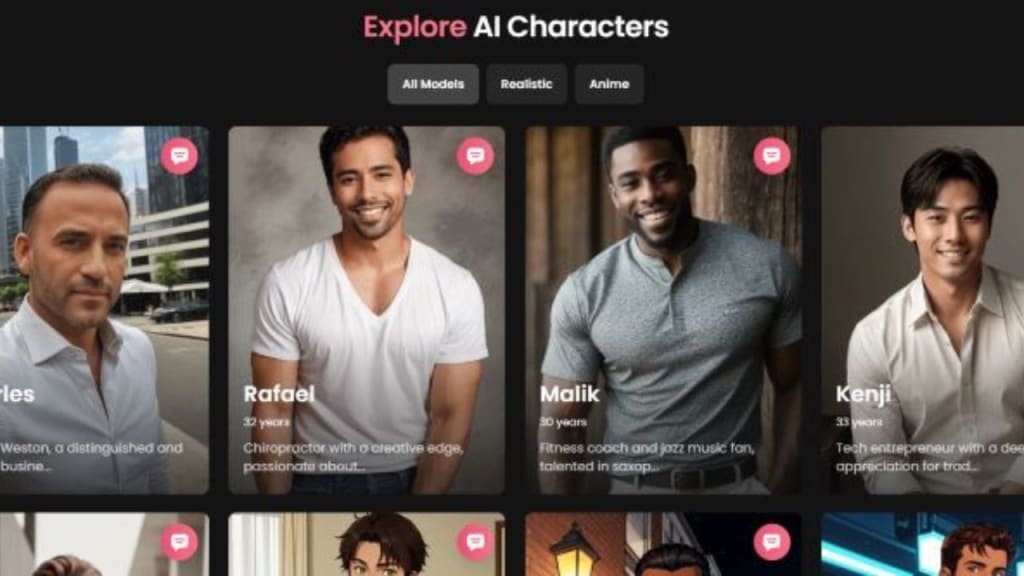
Candy AI is the ultimate AI Gay Sexting platform where users can explore their sexuality and engage in explicit conversations with a wide range of Male and Female AI models. This platform offers an extensive range of AI models in both Anime and Realistic style and each character contains a short description among itself stating the age and personality of the AI model. 

To begin sexting on Candy AI, users need to simply navigate to the official site of Candy AI and select who they are interested in, “Male or Female.” Once you have selected your desired gender, a wide range of AI model options will appear on your screen. Choose your favorite character and begin chatting with them. You can unleash your imagination, desires, fantasies, or anything with your selected character. 

Key Features: 

  • It contains an extensive amount of AI character options in both Males and Females for sexting. 
  • Users can also create a brand new AI character for themselves by customizing its appearance and personality on this platform. 
  • Users can request images in various environments or scenarios to their AI model to feel more connected and gain a personalized experience. 

Pricing:

Candy AI contains two premium plans $12.99/month and $69.99/year. 

2. FAPAI.app

FAPai.app is an AI chatbot platform also designed for gay sexting. FAPai’s Gay AI chatbots bring an enticing twist to AI interactions, offering a unique, satisfying experience that rivals human conversations. With FAPai, users can delve into sensual dialogue with Gay AI personalities crafted to enhance satisfaction and fulfill intimate fantasies.

Features:

  • AI chatbots crafted specifically for gay sexting
  • New fantasy characters are released weekly
  • Offers deep, imaginative conversation beyond basic chat
  • Wide variety of characters to suit diverse tastes
  • 24/7 availability for discreet, private chats

3. CrushOn AI

CrushOn AI is another popular AI chatbot that encourages users to engage in Gay sexting with a variety of AI models. This is a Gay NSFW AI chat platform where users can interact with their desired AI characters and unleash their desires and fantasies without any restrictions. 

CrushOn AI offers a wide range of AI characters in numerous categories such as Anime, MILF, DILF, Fictional, Historical, and much more. Apart from this, users can also create a custom AI character for themselves on this platform for a more personalized gay sexting experience. This way, users can create a character with a custom name, image, definition, personality, and more. 

Key Features:

  • A wide range of AI characters is available in various categories such as Historical, fictional, Action, Game, Anime, Celebrity, and more. 
  • Users can create their customized AI characters on this platform for a personalized experience.
  • It contains a simple and intuitive interface that anyone can access. 

Pricing: 

A free plan is available, paid plans are mentioned below: 

Standard Plan Premium Plan Deluxe Plan 
$5.99/month $14.99/month $49.99/month 

4. PepHop AI 

PepHop AI is an excellent AI chatbot platform that allows users to engage in Gay explicit conversation with a variety of different AI chatbots. Through this platform, users can unleash their desires and talk about everything regardless of their sexual orientation. 

PepHop AI offers a wide range of AI chatbot options in numerous categories such as No Binary, Anime, Male, Female, and more. In addition, users can even design a personalized Gay AI chatbot specially for themselves by customizing its interests and personalities based on individual preferences.

Features: 

  • Users can interact with Gay AI chatbots and ask them to engage in roleplay scenarios and explore their desired fantasies effortlessly. 
  • With PepHop AI users can design their own AI Gay chatbot and generate a custom name, introduction, avatar, etc. 
  • It offers excellent privacy and security measures to ensure the conversation between the user and the AI chatbot remains private and secure. 

Pricing:

Lite Plan Classic Plan Elite Plan
$4.99/month $9.99/month$29.99/month
2,000 messages per month5,000 messages per month16,000 messages per month

5. SpicyChat AI

Just like the name suggests, SpicyChat AI is an AI-powered chatbot that allows users to engage in uncensored and spicy conversations with their desired AI characters. To access Gay AI Sex chat on this platform, users need to start by navigating to the official site of SpicyChat AI and sign up using their email. After this, under the tag sections, type “LGBTQ+” and tap on it, and the platform will display all the gay sexting chatbots. Select any chatbot based on your preferences, and that’s it. You can chat about anything with your chatbot without any restrictions. 

This tool also allows users to generate their own chatbot by providing a Name, Title, Greeting, Chatbot personality, avatar, and tags. Overall, SpicyChat AI is one of the best websites that can provide your spicy gay sexting experience using simple methods. 

Key Features: 

  • SpicyChat AI contains various AI characters in different tags. 
  • This tool allows users to generate their own customized AI chatbot for a personalized experience online. 
  • Users can also engage in roleplay with their desired AI chatbot and engage in unique storylines and scenarios. 

Pricing: 

There are three membership plans available for SpicyChat AI which are mentioned below: 

Get a Taste True Supporter I’m All in 
$5.00/month$14.50/month $24.95/month

6. MyAnima AI

MyAnima AI is one of the best AI Gay Chat Apps where users can truly express their emotions and imagination to their virtual companion. This chatbot is powered by artificial intelligence and allows users to engage in conversations with a variety of AI characters and have a fun experience online. This chatbot is here to provide companionship, roleplay, and more. Not only does this platform listen to everything that you say, but it also understands everything that you feel and express. 

The stand-out part about this platform is that it’s available 24/7; therefore, whether it’s the middle of the night or early morning, if you feel distressed, you can navigate to MyAnima and express your feelings with it. In addition, this tool also offers roleplay features using which users can effortlessly engage in role-play conversations and engage in various unique storylines and scenarios for a fun experience online. 

Key Features: 

  • It contains a mobile application for both iOS and Android devices. 
  • Easy to access as it contains a simple and intuitive interface. 
  • Users can engage in roleplay on this platform. 
  • MyAnima AI is available 24/7. 

Pricing: 

Free, in-app purchasing begins at $2.99. 

7. Talk Dirty AI

Lastly, we have TalkDirty AI. This is another impressive AI-powered chatbot where users can express their imagination and fantasies and talk about anything, including Gay sexting with the AI chatbot without any restrictions. 

To access this platform, users need to visit TalkDirty AI’s official website and sign up using their email address. Once done, Enter an open-ended prompt to set the scene, and let the advanced technology of AI put you on a fascinating journey. Users need to enter a short description of a scene that they like and the AI technology will instantly generate a conversation for them based on their likes. This way you can engage in different scenarios on this platform and have a fun and unique experience sexting.  

Key Features: 

  • This platform allows users to engage in conversations with unique scenarios and storylines. 
  • It contains an active community where users can browse various other storylines and continue the conversations. 
  • It is simple to use. 

Pricing: 

TalkDirty AI contains a premium plan available for $19.99 that provides various advanced features such as unlimited chats, unlimited scenarios, and interactive images. 

Conclusion

Gay AI Chat Apps are excellent AI-powered chatbots that can help generate human-like responses to your sexting requests and fulfill all your desires and fantasies effortlessly. The majority of these platforms not only allow users to engage in gay sexting but also encourage them to create their own custom AI chatbot for a personalized experience. Above we have mentioned 5 Best AI Gay Chat Apps where users can unleash their imagination and engage in unique roleplay effortlessly. 

Posted in AI | Tagged , | Leave a comment

A Visual Guide to the Startup Universe

Posted in startups | Leave a comment

2013 Data Science Salary Survey: Open source tools correlate with higher salary

“In our report, 2013 Data Science Salary Survey, we make our own data-driven contribution to the conversation. We collected a survey from attendees of the Strata Conference in New York and Santa Clara, California, about tool usage and salary…

What did we find?

In a sentence: those who use data tools make more.

More specifically, the tools that correlate with higher salary are scalable and generally open source; they are often script-based or built for machine learning.  Those attendees who tend to use one such tool tend to use others––that is, these tools form a ‘cluster’ in terms of usage among our sample.  Perhaps just as interesting is that some of the traditional, popular tools such as Excel and SAS were not used as widely as R and Python. This might be food for thought for those data analysts who have thus far resisted learning how to code or moving beyond query-based data tools.”

Source: 2013 Data Science Salary Survey 

Posted in Big Data Analytics, Data Science, Data Science Careers, Data Scientists | Leave a comment

The New Apple Wristop Computer: Not Designed for the Internet of Things

MIT Media Lab cofounder Nicholas Negroponte observed at a recent TED event that “I look today at some of the work being done around the Internet of Things and it’s kind of tragically pathetic.”

The “tragically pathetic” label has been especially fitting for wearables, considered the hottest segment of the Internet of Things.  Lauren Goode at Re/Code wrote back in March: “Let me guess: Your activity-tracking wristband is sitting on your dresser or in a drawer somewhere right now, while it seems that every day there’s a news report out about an upcoming wearable product that’s going to be better, cooler, smarter.”

All of this was going to change when Apple finally entered the category with its smart watch. Many observers hoped that Apple’s design principles, obsession with simplicity, and track record of delighting users with easy-to-use products, are going to finally give the world a useful and fun wearable.

Instead, we got a good-looking wrist-top computer. Not a simple, intuitive, and focused device but a generic, complex product with too many functions and options. Kevin McCullagh wrote in fastcodesing.com: “I can’t help but think Steve Jobs would have stopped the kitchen sink being thrown in like this. Do we really need photos and maps on a stamp-sized screen, when our phones are rarely out of reach? For all the claims of a ‘thousand no’s for every yes,’ the post-Jobs era is shaping up to be defined by less ruthless focus.” Back in June, Adam Lashinsky already made this general observation about the potential loss of the famed product development discipline: “Apple, once the epitome of simplicity, is becoming the unlikely poster child for complexity.”

“Complexity,” however, does not tell the whole story. By introducing a watch that is basically a computer on your wrist, Apple missed an opportunity not just to reorient the wearables market to something much better than “tragically pathetic,” but also to define the design and usability principles for the Internet of Things.

In his TED talk, Negroponte highlighted what he called “not a particularly enlightened view of the Internet of Things.” This is the tendency to move the intelligence (or functionality of many devices) into the cell phone (or the wearable), instead of building the intelligence into the “thing,” whatever the thing is – the oven, the refrigerator, the road, the walls, all the physical things around us. More generally, it is the tendency to continue evolving the current computer paradigm—from the mainframe to the laptop to the wristop computer—instead of developing a completely new Internet of Things paradigm.

The new paradigm should embrace and evolve the principles of what was once called “ubiquitous computing.” The history of that vision over the last two decades may help illuminate where the Internet of Things is today and where it may or may not go.

In 1991, Mark Weiser, then head of the Computer Science Lab at Xerox PARC, published an article in Scientific American titled “The Computer for the 21st Century.” The article opens with what should be the rallying cry for the Internet of Things today: “The most profound technologies are those that disappear. They weave themselves into the fabric of everyday life until they are indistinguishable from it.”

Weiser went on to explain what was wrong with the personal computing revolution brought on by Apple and others: “The arcane aura that surrounds personal computers is not just a ‘user interface’ problem. My colleague and I at the Xerox Palo Alto Research Center think that the idea of a ‘personal’ computer itself is misplaced and that the visions of laptop machines, dynabooks and ‘knowledge navigators’ is only a transitional step toward achieving the real potential of information technology.  Such machines cannot truly make computing an integral, invisible part of people’s lives.”

Weiser understood that, conceptually, the PC was simply a mainframe on a desk, albeit with easier-to-use applications.  He misjudged, however, the powerful and long-lasting impact that this new productivity and life-enhancing tool would exert on millions of users worldwide. Weiser wrote: “My colleagues and I at PARC believe that what we call ubiquitous computing will gradually emerge as the dominant mode of computer access over the next 20 years. … [B]y making everything faster and easier to do, with less strain and fewer mental gymnastics, it will transform what is apparently possible. … [M]achines that fit the human environment instead of forcing humans to enter theirs will make using a computer as refreshing as taking a walk in the woods.”

Ubiquitous computing has not become the “dominant mode of computer access” mostly because of Steve Jobs’ Apple. It successfully invented variations on the theme of the Internet of Computers: The iPod, the iPhone, the iPad. All of them beautifully designed, easy-to-use, and useful. All of them cementing and enlarging the dominance of the Internet of Computers paradigm. Now Apple has extended the paradigm by inventing a wristop computer. That the Apple Watch is more complex and less focused than Apple’s previous successful inventions matters less than the fact that it continues in their well-trodden path.

While the dominant paradigm has been reinforced and expanded by the successful innovations of Apple and others, the vision of ubiquitous computing has not died. Today, when we are adding intelligence to things at an accelerating rate, it is more important than ever. Earlier this year, I asked Bob Metcalfe what is required to make us happy with our Internet of Things experience. “Not so much good UX, but no UX at all,” he said. “The IoT should disappear into the woodwork, even faster than Ethernet has.” Metcalfe invented the Ethernet at Xerox PARC at the time Weiser and others were working on making computers disappear.

Besides ubiquity, there are at least two other dimensions to the new paradigm of the Internet of Things. One is seamless connectivity. In response to the same question, Google’s Hal Varian told me, “I think that the big challenge now is interoperability. Given the fact that there will be an explosion of new devices, it is important that they talk to each other. For example, I want my smoke alarm to talk to my bedroom lights, and my garden moisture detector to talk to my lawn sprinkler.” No more islands of computing, a hallmark of the Internet of (isolated) Computers.

Another important dimension of the new paradigm is useful data. Not big or small, nor irrelevant or trapped in a silo, just useful. The value of the “things” in the Internet of Things paradigm is measured by how well the data they collect is analyzed and how quickly useful feedback based on this analysis is delivered to the user.

Disappearing into the woodwork. All things talking to all things. Useful data. It may not be Apple, but the company or companies that will master these will usher in the new era of the Internet of Things where we finally get over our mainframe/PC/Wristop computer habit.

[Originally published on Forbes.com]

Posted in Internet of Things | Leave a comment

Big Data Quotes: Einstein, Come Back When You’ve Got Data

“Big data is what happened when the cost of storing information became less than the cost of making the decision to throw it away”—George Dyson (quoted by Tim O’Reilly)

“If the engineers have their way, every idea, memory, and feeling—the recorded consciousness of a single lifetime—will be stored in the cloud… ‘Information overload’ once referred to the difficulty of absorbing intelligently the data produced by others. Now we face the peril of choking on our own…By remembering everything, we may become haunted by our pasts and immobilized by digital distractions—or we may gain new powers to prevent the bad and promote the good”—G. Pascal Zachary

“[I]n a world where massive datasets can be analysed to identify patterns not easily identified using simpler analogue methods, what happens to genius of the Einstein variety?

Genius is about big ideas, not big data. Analysing the attributes and characteristics of anything is guaranteed to find some patterns. It is inherently a theoretical exercise, one that requires minimal thought once you’ve figured out what you want to measure. If you’re not sure, just measure everything you can get your hands on. Since the number of observations — the size of the sample — is by definition huge, the laws of statistics kick in quickly to ensure that significant relationships will be identified. And who could argue with the data?

Unfortunately, analysing data to identify patterns requires you to have the data. That means that big data is, by necessity, backward-looking; you can only analyze what has happened in the past, not what you can imagine happening in the future. In fact, there is no room for imagination, for serendipitous connections to be made, for learning new things that go beyond the data. Big data gives you the answer to whatever problem you might have (as long as you can collect enough relevant information to plug into your handy supercomputer). In that world, there is nothing to learn; the right answer is given…

What if Albert Einstein lived today and not 100 years ago? What would big data say about the general theory of relativity, about quantum theory? There was no empirical support for his ideas at the time — that’s why we call them breakthroughs.

Today, Einstein might be looked at as a curiosity, an ‘interesting’ man whose ideas were so out of the mainstream that a blogger would barely pay attention. Come back when you’ve got some data to support your point”—Sidney Finkelstein

Posted in Big Data Analytics, Quotes | Leave a comment

The CIO Interview: Annabelle Bexiga, TIAA-CREF

“Innovation is everyone’s job,” Annabelle Bexiga, EVP and CIO at TIAA-CREF told me recently. “The most mundane thing,” says Bexiga, “even stacking servers in the data center, can be innovative if you can think of a different way of doing it.”

Contrary to repeated predictions heralding the end of IT innovation, IT is now synonymous with the ever-changing technological landscape of all aspects of our lives. It is also synonymous, for the most part, with business innovation, as IT transforms all business activities from operations to manufacturing to customer relations.

At TIAA-CREF, the IT organization is innovating in support of the growth and expansion of the business. Founded in 1918 to provide retirement services to university faculty, TIAA-CREF is expanding to provide a wider range of financial services and establish a growing presence in other not-for-profit sectors, including health care, research, cultural organizations, and the public sector.  It is already one of the largest pension funds in the U.S., with $520 billion of assets under management, serving 3.9 million active and retired individuals, in addition to institutional investors, retirement plan sponsors, and financial planners.   Continue reading

Posted in Digitization | Leave a comment

The Data Scientist Will Be Replaced By Tools

We just started to use the term “data scientist” and the demise of this new profession is already predicted? Well, at least it’s not one more “rise of the machines” prophecy; it’s the provocative title of a proposed panel for the upcoming SXSW.

The organizer of the panel, Scott Hendrickson of Gnip, has provided a useful run-down of some of the arguments for and against the possible disappearance of data scientists. Supporting the proposition are the current scarcity of data science talent and a slew of startups providing “data science as a service.” As an example of the opposition to the “democratization of algorithms,” Hendrickson quotes Cathy (Mathbabe) O’Neil who wrote recently that “if your model fails, you want to be able to figure out why it failed. The only way to do that is to know how it works to begin with. Even if it worked in a given situation, when you train on slightly different data you might run into something that throws it for a loop, and you’d better be able to figure out what that is.” In other words, machines will never have the deep understanding of the tools of data science that is required to practice data science.   Continue reading

Posted in Data Science, Data Scientists | Leave a comment

Doing Data Science at Manheim

As ones and zeros eat the world, data is the new product and data science is the new process of innovation.

The International Institute for Analytics predicts that in 2014 companies in a variety of industries will increasingly use analytics on the data they have accumulated to develop new products and services. NewVantage Partners’ most recent Big Data Survey reports that 68% of executives felt that “new product innovations” was the greatest value to their organization from big data. In releasing the Accenture Technology Vision 2014, Accenture’s CTO Paul Daugherty said that “Digital is rapidly becoming part of the fabric of [large enterprises’] operating DNA and they are poised to become the digital power brokers of tomorrow.”

The best example of this trend I’ve encountered recently came from an industry one does not necessarily associate with data crunching and analysis—the vehicle remarketing industry, better known as used cars auctions. In 2012, Manheim, a subsidiary of Cox Enterprises, handled nearly 8 million used vehicles, facilitating transactions representing more than $50 billion in value.  With annual revenues of more than $2.5 billion, Manheim offers its services in 14 countries, from physical and online auction channels to financing, transportation, and mobile solutions. Manheim’s research and consulting arm, Manheim Consulting, provides market intelligence and publishes the monthly Used Vehicle Value Index and the annual Used Car Market Report (see here for the 2014 version).

Manheim has provided for free this type of analysis, seeing it as part of the value it offers to auto dealers who are members of its network.  But now it has moved into using its deep knowledge of the used car market and its analytics expertise to offer a new, fee-based service.  Shifting the analytics team from supporting the business to generating revenues, “we’ve decided to look at how we can help dealers in managing the risk associated with their inventory,” T. Glenn Bailey told me.

Bailey is Senior Director of Enterprise Product Planning at Manheim, and his responsibilities include market segmentation, forecasting, and optimization.  He and his team started testing last year a new service called DealShield. The idea came from the financial markets, specifically put option contracts. Just like a put option protects the buyer from a decline in the price of a stock below a specified price, so does DealShield offer a guarantee that Manheim will buy a car back from the dealer, within a certain time frame, for what they paid for it plus the fee they paid.  “It is as if they never bought the car,” says Bailey.

Manheim’s market knowledge and analytics skills give it confidence in its estimates of the value of a car and what they would be able to offer for it if it comes back to them. “We see a lot of value in it,” says Bailey, “because one of the things dealers like to have is liquidity. They use wholesale financing to buy used cars and typically repay the loan within seven to fourteen days. The inventory that’s sitting out there is money that is tied up. DealShield allows them to get out of that car and get their money back in a certain period of time.”

To do their analysis, the Manheim team uses tools that have served this purpose for years, demonstrating that for certain types of analysis and data you can do data science without using any of the new big data technologies. The data is collected and stored in an IBM DB2 database and the analysis is done using a variety of SAS analytics tools.  “The need to combine data from different sources is why we moved into a SAS cloud,” says Bailey. “I wanted our analyst team to be focused on the analytics and not worry about the administrative side.”

Speaking of the analyst team, Bailey says that “we are in the same market for analytics and data science talent with everybody.” In the competition for these hard-to-find professionals, Bailey looks for creativity, communications skills and willingness to learn the business. “In my experience,” he says, “it is fairly easy to tell if you have the technical chops.” He spends most of the time when he interviews people trying to determine if they are creative and can come up with new ideas on how to apply analytics tools to the data to find new insights. “Reversing the flow of cause and effect,” Bailey calls it. “Maybe optimization can tell us where to send a vehicle to maximize value.”

In addition to looking for “people that can bring technology to the business,” Bailey also looks for people who are comfortable with “getting with the business itself.” He calls it “putting on the polo shirt,” spending time with the dealers and getting engaged with them to understand their business first-hand.  This practical bent does not stop with the hiring of the right people but continues with establishing the right work environment and a “fail-fast” culture. “In some sense,” says Bailey, ”failure is rewarded because it means you are testing this thing out.” When they developed DealShield, “we had a chart that over a 2-month period showed all the things that failed. If it doesn’t work, kill it.”

In addition to being the first knowledge-based service that is expected to bring in a new revenue stream, DealShield breaks new ground for Manheim because it is the first time the company actually owns cars (when they come back from the dealer), not just acting as a middle-man. That became an opportunity for an analyst on Bailey’s team to hone further her knowledge of the business.  “She is now responsible for selling the cars. She is setting the auction, the floor price, where to run the auction,” says Bailey.

Doing data science means engaging with the business, inventing new data-based products, even becoming an integral part of revenue stream for the business.

[Originally published on Forbes.com]

Posted in Data Science, Data Scientists | Leave a comment