
Protecting personal data has become a top priority for both individuals and organizations. With the increasing frequency of cyberattacks, data breaches, and widespread tracking, people are growing more concerned about how their information is collected, stored, and used. Companies and governments are under pressure to strengthen data security, while users seek more control over their personal information. In this article, we will explore 23+ alarming data privacy statistics for 2026, revealing consumer concerns, risks, and much more.
Global Consumer Concerns on Data Privacy

90% of the Internet users believe privacy is crucial
90% of U.S. internet users consider online privacy important, reflecting strong national awareness of digital security issues. However, 75% believe they are vulnerable to cybercriminal attacks, showing a widespread sense of risk. Despite this concern, only 64% report using privacy tools such as VPNs or security software, and just 56% feel they have control over their personal data.
21 U.S. States Adopt Data Privacy Laws by Early 2026
As of early 2026, 42% of U.S. states, which equals 21 states, have passed data privacy laws aimed at protecting residents’ personal information. These laws typically give individuals more control over how companies collect, store, and share their data.
85% of Internet Users Want Stronger Privacy Protection
A global survey of 10,000 adults across 10 countries (2022) revealed strong concerns about data privacy worldwide. 85% of respondents said they want to do more to protect their online privacy, showing a clear desire for greater control over personal data. However, the findings also highlight ongoing challenges: 80% are concerned about their privacy, and 69% say they are more worried than ever before.
| Data Privacy Concerns | Share of respondents |
| Concerned about their privacy | 80% |
| Say they are more worried than ever before | 69% |
| Willing to sacrifice data privacy in exchange for convenience | 61% |
| Thinks it’s impossible to protect privacy | 55% |
| Don’t know how to protect personal data | 51% |
Despite these concerns, 61% admit to sacrificing privacy for convenience, while 55% believe it’s impossible to protect their privacy fully. Additionally, 51% say they don’t know how to protect their personal data, underscoring the need for better education and accessible privacy tools.
Majority of Consumers Say Tech Firms Hold Excessive Power Over Personal Data
Tech giants like Meta collect personal data on billions of people, fueling global privacy concerns. In the UK and Spain, 75% of adults believe tech companies have too much control over their data. Concern is particularly strong among older generations: 70% of Baby Boomers feel tech companies overreach, compared to 59% of Gen Z.
Most Americans Feel They Can’t Escape Data Collection
According to a Pew Research Center survey, most Americans believe it’s impossible to avoid data collection by both companies and the government. 62% of respondents said they cannot go through daily life without companies gathering their data, while 63% said the same about government agencies. This constant collection has become a major source of concern, with 79% worried about how companies use their personal information and 64% expressing similar concerns about government use.
25% of U.S. Users Asked to Accept Privacy Policies Every Day
1 in 4 Americans are asked to agree to a privacy policy every day, reflecting how frequently people encounter data consent requests online. An additional 57% face them at least weekly, and 81% say they see them at least once a month. Despite their prevalence, only 22% of Americans report reading privacy policies in full, suggesting that most users agree to terms without fully understanding how their data will be collected or used.
Most Companies Rely on Multi-Factor Authentication to Secure Cloud Data
To protect data in the cloud, companies are increasingly adopting security measures. 69% use multi-factor authentication (MFA) to strengthen access control, 63% rely on cloud backups to prevent data loss, and 62% implement encryption to secure sensitive information, reflecting a growing commitment to safeguarding digital assets.
Explore More: Generative AI Market Size: Growth, Trends (2026–2034)
Mobile Data Privacy Statistics

82.78% of iOS Apps Collect Personal Information
Around 82.78% of iOS apps, about 1.55 million in total, track some form of private user data, highlighting the widespread nature of digital surveillance even within Apple’s ecosystem, which is often marketed as privacy-focused. Additionally, 31.73% of apps (around 594,000) use data directly linked to users, such as contact information, identifiers, or usage data.
| Category | Percentage of iOS Apps |
| Track private user data | 82.78% of iOS apps (1.55 million) |
| Use data linked to users | 31.73% of iOS apps (594,000) |
| have access to users’ background location | 18.44% of iOS apps (345,000) |
| Use data to track users | 15.31% of iOS apps (287,000) |
49% of Android Apps Include at Least One Data Tracker
As of 2023, nearly half of all apps (49%) on the Google Play Store contained at least one third-party tracker, revealing how widespread data tracking has become in the mobile ecosystem. Even more concerning, over 17% of apps included more than 10 trackers, indicating extensive data collection and sharing with multiple external entities.
High Data Tracking Levels Found in Social and Delivery Apps
An analysis of the privacy policies of over 200 popular apps found that social media and food delivery apps collect the most user data on average. Among all app categories, shopping apps gather around 18 data points per user, while dating apps collect about 16. In contrast, browsers, image editors, and kids’ apps were found to collect the least amount of user data.
Sensitive Permissions Common Among Top Free Apps Across Stores
Research shows that 90% of the top free apps on both the Google Play Store and Apple App Store request sensitive data permissions, such as access to a user’s location and contacts. In addition, a significant number of these apps also request microphone permissions, raising further privacy concerns.
Data Breach Statistics
Average Daily GDPR Breach Notifications Rise from 335 to 363 in One Year
Between January 28, 2024, and January 27, 2025, the average number of GDPR breach notifications per day rose from 335 to 363, indicating a growing number of reported data breaches across Europe. During this period, the Netherlands reported the highest number of breaches (33,471), followed by Germany (27,829) and Poland (14,286).
Around 1,774 Data Breach incidents were reported in 2022
In 2022, data breaches impacted 422 million people, averaging 4.8 breaches per day. The types of sensitive information exposed were significant: 1,560 breaches leaked names, 1,143 leaked social security numbers, 565 leaked home addresses, 465 leaked medical histories, and 443 leaked bank account numbers
Data Breach Costs Average $4.44 Million Worldwide in 2026
In 2026, the global average cost of a data breach is estimated at USD 4.44 million. In the United States, the average cost per breach rose to a record USD?10.22?million in 2026. These numbers reflects the significant financial impact that breaches can have on organizations worldwide, including costs related to incident response, legal fees, regulatory fines, and reputational damage.
Data Breaches Rising as Shadow AI Creates New Security Risks
Around 20% of organizations experience data breaches caused by security incidents involving shadow AI. Shadow AI refers to the use of artificial intelligence tools within a company without official approval or oversight from IT or security teams. These unmonitored tools can create vulnerabilities, as sensitive data may be processed or shared outside established security protocols, increasing the risk of breaches and compliance issues.

Almost Half of UK Businesses Fall Reported Cybersecurity Breach
In the UK, 43% of businesses and 30% of charities reported experiencing cybersecurity breaches or attacks in the past year, highlighting significant vulnerability across sectors and emphasizing the critical need for stronger security measures and proactive data protection strategies.
Nearly Half of the Data Breaches Contain User Names, Emails, and Passwords
Personal information, including usernames, passwords, and email addresses, is the most frequently exposed data in breaches. Because many internet users reuse the same credentials across multiple platforms, a single breach can potentially compromise numerous accounts, amplifying the risk and impact of the attack.
Healthcare Sector Continues to Be the Primary Target for Data Breaches
Between 2021 and 2024, the United States experienced an average of 727 large healthcare data breaches per year, highlighting the sector’s high vulnerability. In Australia, the healthcare sector also consistently reports the highest number of breaches to the Office of the Australian Information Commissioner (OAIC).
Across all sectors in Australia, the total number of breaches is lower than the U.S. figure, with 527 breaches reported in just the first six months of 2024, emphasizing that healthcare remains a critical target for data breaches globally.
Hackers Pose the Greatest Threat to Cloud Data Security
Among IT professionals, 55% identify hackers as the top threat to data privacy in cloud infrastructures. While Internal actors are also seen as major risks: 39% consider employees and 36% cite contractors or partners as potential sources of data breaches, highlighting that both external and trusted insiders pose significant security challenges.
Read more about Conversational AI Market Size, Growth Trends (2023 to 2034)
Business-Related Data Privacy Statistics
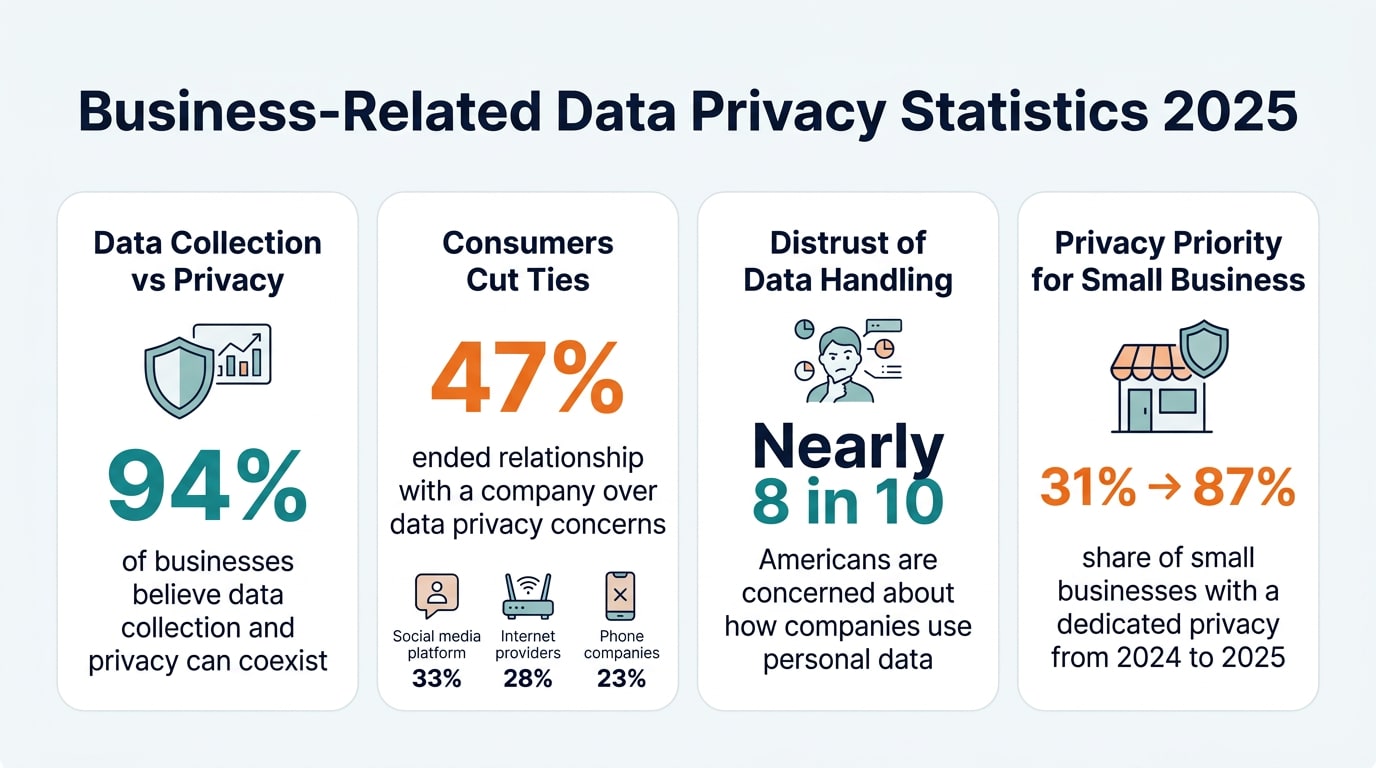
94% of Businesses Believe Data Collection and Privacy Can Coexist
Around 94.1% of businesses believe it is possible to strike a balance between collecting data for marketing purposes and respecting customer privacy. This overwhelming majority suggests that most organizations recognize the importance of ethical data practices, aiming to personalize marketing efforts without compromising user trust.
47% of Global Consumers Cut Ties with Businesses Over Data Privacy Concerns
Around 47% of adults have ended their relationship with a company due to concerns about its data privacy practices. The data shows how strongly consumers value data protection and transparency. Among those who cut ties, 33% stopped using social media platforms, 28% switched internet providers, and 23% left phone companies over privacy issues.
Nearly 8 in 10 Americans Distrust How Companies Handle Personal Data
According to a Pew Research Center study, 79% of Americans are concerned about how companies use their personal data. This shows that a large majority of people are uneasy about how their information is collected, shared, and stored by businesses.
Privacy Becomes a Priority for Small Businesses
Companies earning less than US$50 million a year, the number with a dedicated privacy office rose sharply from 31% in 2024 to 87% in 2026. This big increase shows that even smaller businesses are now taking data protection more seriously and working to meet new privacy rules while building trust with their customers.
Most Consumers Feel Left in the Dark on How Their Data Is Used
63% of users believe most companies are not transparent about how their data is used. Many users feel that businesses collect and share personal information without providing clear explanations or consent options, emphasizing the urgent need for greater openness and accountability in corporate data practices.
80% of Companies Store Sensitive Data in the Cloud
The majority of companies rely on multiple cloud platforms for their daily operations, with 4 in 5 storing sensitive data in the cloud. Specifically, 44% use cloud services to store customer data, and another 44% keep employee data in the cloud, highlighting the central role of cloud computing in modern data management.
77% of Consumers Say Yes to Email Sharing for Better Deals
Nearly 77% of consumers are willing to share their email address in exchange for personalized experiences or additional incentives. This indicates that while privacy concerns remain high, many users are still open to sharing certain personal details when they see clear value in return.
Over Half of U.S. Consumers Say Data Collection Influences Their Choices
According to the Pew Research Center, 52% of American users have decided not to use a product or service because of concerns about how much personal data would be collected. Many users are willing to forgo convenience or features if they feel their personal information might be at risk, underscoring how trust and transparency have become key factors in customer decision-making.
Read more about Data Analytics Market Size, Growth Statistics (till 2035)
Wrapping Up
The data privacy landscape in 2026 makes it clear that both individuals and organizations face significant challenges in protecting personal information. From rising cyber threats to widespread data tracking, the statistics highlight how crucial it is to stay informed and take proactive measures. Businesses must prioritise transparency and strong security practices, while users need to remain vigilant about their digital footprint.
