
AI agent systems are being used more and more in businesses for automation and decision-making, but many of them still fail to work properly in real-world conditions. Even though the technology is improving quickly, a large number of projects never make it past testing. In fact, about 88% of AI agent projects fail to reach production, and only around 12% successfully go live.
Common problems include poor data quality, unclear goals, system errors, security risks, and failures in multi-step tasks that become harder to manage as the process grows. Because of this, many companies get stuck in the “pilot stage,” where the AI works in tests but fails when used in real operations. In this article, we are going to explore AI Agent failure rate statistics along with key insights into why these failures happen, the most common causes behind them, and more.
Key AI Agent Failure Rate Statistics
- 88% of AI agent projects fail to reach production, meaning only ~1 in 8 systems successfully transition from pilot to real-world deployment.
- Only ~12% of AI agent initiatives successfully reach production.
- ~80% of AI projects fail to deliver measurable business value, showing that most AI investments do not translate into ROI.
- Over 40% of agentic AI projects are expected to be canceled by 2027, driven by cost overruns and weak ROI.
- Less than 20% of AI pilot projects scale into full production systems, reinforcing widespread deployment breakdowns.
- Up to 90% of AI projects may ultimately fail or underperform, depending on scope and industry estimates.
- AI agent failures in production can range from 70% to 95%, especially in complex or multi-step workflows.
- Scope creep alone accounts for 34% of AI agent failures, making it the single largest reported failure driver.
ALSO READ: AI Agents Statistics: Usage And Market Insights (2025 to 2030)
AI Agent Project Failure & Cancellation Statistics

88% of AI Agent Projects Fail Before Reaching Production
About 88% of AI agent projects fail to reach the production stage, showing that many projects struggle to move beyond testing and development. This means that nearly 9 out of 10 projects get stuck before becoming fully usable systems.
This situation, often called “pilot purgatory,” happens because many teams focus on building impressive prototypes while ignoring important areas such as monitoring tools, human support systems, security measures, and reliable infrastructure.
| AI Agent Project Outcome | Percentage |
| AI agent projects that never reach production | 88% |
| AI agent projects that successfully reach production | 12% |
Source: Medium
4 Out of 5 AI Initiatives Struggle to Produce Measurable Results
Around 80% of AI projects do not generate the business value organizations expect, showing that many initiatives struggle to turn investments into measurable results. In practical terms, only about 1 in 5 projects successfully achieves its intended objectives, while the majority fall short of expectations.
Factors such as poor planning, unclear goals, weak data quality, implementation challenges, and difficulties integrating AI into existing business processes often contribute to these outcomes.
Over 40% of Agentic AI Projects Expected to Fail by 2027
According to Gartner, more than 40% of agentic AI projects are expected to be canceled by the end of 2027, signaling a substantial risk of project attrition within the emerging AI ecosystem.
The forecast suggests that escalating implementation costs, weak return on investment (ROI), and insufficient risk management frameworks are the primary factors driving project discontinuation. Statistically, this indicates that nearly two out of every five organizations investing in agentic AI initiatives could struggle to sustain long-term deployment efforts.
Tool Misuse Drives 31% of AI Agent Production Failures
The production failure data shows that operational and execution-related issues are among the biggest challenges for AI agents. Tool misuse and incorrect tool arguments emerged as the most common failure mode, accounting for 31% of production failures, followed by context drift and hallucination cascades at 27%.

Scope creep represented 19% of failures, indicating that AI agents often exceed their intended boundaries or responsibilities. Data quality issues contributed 17%, while prompt injection and security exploits accounted for 14% of failures.
| AI Agent Failure Mode | Frequency |
| Tool misuse & incorrect tool arguments | 31% |
| Context drift & hallucination cascades | 27% |
| Scope creep (agents exceed defined mandate) | 19% |
| Data quality failures (garbage-in-garbage-out) | 17% |
| Prompt injection & security exploits | 14% |
| Infinite loops & runaway costs | 12% |
| Silent quality degradation (no error raised) | 11% |
Source: Trantor
Lower but still notable causes included infinite loops and runaway costs at 12%, along with silent quality degradation at 11%, where performance declines without generating visible errors. The findings suggest that AI agent failures are not caused by a single factor but instead result from a combination of reliability, security, and workflow management challenges that affect real-world deployment performance.
9 Out of 10 AI Agent Projects May Struggle to Reach Their Goals
Some estimates suggest that up to 90% of AI Agent projects may be stopped or fail to provide the expected results by 2026. This means that nearly 9 out of 10 AI projects could struggle to achieve their goals.
Common reasons include unclear project goals, poor-quality data, high costs, technical challenges, and unrealistic expectations about what AI can do. The estimate shows that success depends not only on the technology itself but also on good planning, strong management, and clear business strategies.
Less Than 20% of AI Pilot Projects Reach Full Production
Fewer than 20% of AI pilot projects successfully move into full production environments. This means that less than 1 out of every 5 AI projects tested in the pilot stage becomes a fully implemented system. The numbers suggest that while many organizations start AI experiments, only a small percentage are able to scale them successfully for real-world use.
AI Agent Reliability & Workflow Failure Statistics
85% Step Accuracy Can Drop to Just 20% Workflow Success
An AI agent with 85% accuracy at each individual step can experience a major drop in overall performance when handling longer workflows. In a process with 10 consecutive steps, the total success rate can fall to around 20%, meaning only about 1 in 5 complete tasks may be finished successfully. This happens because small errors at each stage can build up over multiple steps, increasing the chance that the entire workflow will fail.
95% Step Accuracy Can Fall to Just 36% Across 20-Step Workflows
Even when an AI agent performs correctly 95% of the time at each step, its overall performance can drop significantly in longer workflows. In a process with 20 steps, the total success rate can fall to only 36%, meaning that only about 1 out of 3 tasks may be completed successfully from beginning to end. This happens because small errors at each step can build up over time.
Only 6 in 10 Long AI Workflows May Finish Successfully
An AI agent with 95% accuracy at each individual step may still experience a noticeable decline in performance when completing longer workflows.
In a process containing 10 connected steps, the overall success rate can drop to around 60%, meaning that only about 6 out of 10 tasks may be completed successfully from start to finish. This occurs because even small errors at each stage can accumulate as the workflow becomes longer.
Three AI Agents at 70% Success Each Result in Only 34% Workflow Success
When multiple AI agents are connected in a workflow, the overall success rate can decrease quickly even if each individual agent performs reasonably well. If three linked agents each have a 70% success rate, the complete workflow succeeds only about 34% of the time. This means that roughly only 1 out of 3 tasks will be completed successfully from start to finish. The drop happens because each additional step or agent creates another chance for failure.
Production AI Agents Face Failure Rates as High as 95%
Failure rates for AI agents in production environments can range from 70% to 95%, depending on the complexity of the tasks being performed. This means that between 7 and 9.5 out of every 10 tasks may fail under certain real-world conditions.
Simpler tasks often experience lower failure rates, while more advanced workflows involving multiple steps, decision-making, or system integrations tend to have higher failure levels. The large difference in outcomes suggests that task complexity plays a major role in overall AI performance.
Only 1 in 4 Consecutive AI Task Sequences May Finish Successfully
Performance can drop significantly when AI agents are required to complete multiple tasks in sequence rather than a single task. An AI agent with a 60% success rate in one run may see its overall success rate decrease to around 25% when measured across eight consecutive runs.
This means that only about 1 in 4 complete sequences may be successful. The reduction happens because small failures can build up over repeated attempts, making it harder to maintain consistent results throughout the entire process.
WebArena Results Reveal a 14.41% Success Rate for Leading AI Agents
The best GPT-4-based agents achieved a task completion rate of only 14.41% on the WebArena benchmark, showing the difficulty AI systems face when handling complex web-based tasks. This means that the agents successfully completed only about 14 out of every 100 assigned tasks, while the remaining tasks were not completed successfully.
AI Agent Failure Cause Statistics
34% of Respondents Cite Scope Creep as the Top Failure Driver
The distribution of AI agent pre-production failures shows that project challenges are concentrated around a few dominant risk areas. Among respondents, scope creep emerged as the leading cause of failure, accounting for 34% of cases, indicating that expanding project requirements and unclear objectives are the most common obstacles during development.

Data quality failure ranked second at 27%, highlighting the significant impact of incomplete, inaccurate, or inconsistent data on AI agent performance. Security blockers represented 14% of failures, reflecting concerns around privacy, compliance, and risk management.
| AI Agent Failure Pattern Distribution | Percentage |
| Scope Creep | 34% |
| Data Quality Failure | 27% |
| Security Blockers | 14% |
| Integration Complexity | 9% |
| Cost Overruns | 7% |
| Governance Gaps | 5% |
| Organizational Resistance | 4% |
Source: DigitalApplied
Other contributing factors included integration complexity (9%), cost overruns (7%), governance gaps (5%), and organizational resistance (4%). Although the latter factors occur less frequently, they remain meaningful barriers that can undermine deployment success.
88% of Organizations Using AI Agents Report Security Problems
A recent survey found that 88% of organizations using AI agents have faced security problems. This shows that security issues are very common in real-world use, not just rare cases. The results suggest that as more companies adopt AI agents, security risks remain a serious concern and better protection and monitoring are needed.
AI Agents Score 20% to 40% Higher When Only Final Outputs Are Evaluated
AI agents evaluated only on their final outputs appear to perform significantly better than they actually do when the full process is analyzed. In fact, they can pass 20% to 40% more tests when only the end results are considered compared to evaluations that examine the complete execution trajectory.
This suggests that focusing only on final outputs can overestimate performance, while deeper evaluation methods reveal more hidden errors in the decision-making process.
60% of AI Projects Without AI-Ready Data Are Expected to Be Abandoned
A significant portion of AI initiatives are at risk when proper data infrastructure is missing. Around 60% of AI projects that do not have AI-ready data are expected to be abandoned. This highlights how critical data quality and preparedness are for project success, as insufficient or unstructured data often prevents models from being effectively trained or deployed, leading many projects to fail before reaching production.
Technical AI Agent Failure Statistics
AI Agent Failures Follow Repeated Patterns Rather Than Isolated Incidents
Researchers examined 1,675 AI-agent executions in a cloud root-cause-analysis benchmark and identified recurring problems across 12 different pitfall categories. The findings suggest that AI agent failures are not isolated incidents but repeated patterns that appear across many executions.
By analyzing a large sample of runs, the study showed that errors can arise from multiple sources, including reasoning issues, workflow problems, system interactions, and execution failures. The results highlight that as AI agents handle more complex tasks, understanding and addressing common failure patterns becomes important for improving reliability and overall performance in production environments.
AI Agent Studies Show Frequent Errors in Data Interpretation and Reasoning
One of the most common problems in AI-agent systems is hallucinated data interpretation, according to researchers. This happens when an AI produces or reads information incorrectly but still presents it as if it is correct, and it shows up often across different tests and evaluations. These kinds of mistakes can seriously reduce the reliability of AI outputs.
The results indicate that many AI-agent failures are not due to system errors or crashes, but instead come from incorrect reasoning about data. This highlights an important challenge in building AI systems: they must not only generate clear responses but also stay accurate and factually consistent when working with real-world information.
15-Point Reduction in AI Failures After Upgraded Agent Coordination
A noticeable improvement was observed when communication protocols between AI agents were enhanced. In particular, certain types of multi-agent failures dropped by up to 15 percentage points after these improvements were introduced.
This suggests that coordination issues between agents play a significant role in overall system reliability, and that even relatively simple changes in how agents share and process information can lead to meaningful performance gains.
77 Technical Barriers Impact AI Agent Performance and Deployment
A large-scale analysis identified a total of 77 distinct technical challenges that impact the deployment and reliability of AI-agent systems. These challenges span multiple areas of system design and operation, indicating that failures are not caused by a single issue but by a wide range of technical limitations.
115 Failed Runs Highlight Systematic Patterns in AI Agent Malfunctions
A benchmark study analyzed 115 documented failed AI-agent runs to better understand recurring breakdown patterns. By examining these failure trajectories in detail, researchers were able to identify repeated issues that contribute to system malfunction.
The results show that AI-agent failures are often not random, but instead follow recognizable patterns across different runs, highlighting the value of systematic failure analysis for improving overall system reliability.
AI Agent Failure Cost Statistics
Abandoned AI Initiatives Cost Enterprises an Average of $7.2 Million Each
Investing in AI agent resilience has clear financial implications. S&P Global’s 2025 analysis found that the average sunk cost for each abandoned large enterprise AI initiative is $7.2 million. This indicates that when AI projects fail after significant development, organizations can lose substantial resources.
AI Project Failures Cost Enterprises $16.5 Million Annually in 2025
In 2025, large enterprises abandoned an average of 2.3 AI initiatives each, indicating that project failures were relatively common at scale. This level of abandonment translated into substantial financial losses, with the average large enterprise losing about $16.5 million in a single year due to discontinued AI projects.
This shows the high cost of unsuccessful AI adoption and emphasizes the importance of better planning, execution, and risk management to reduce wasted investment.
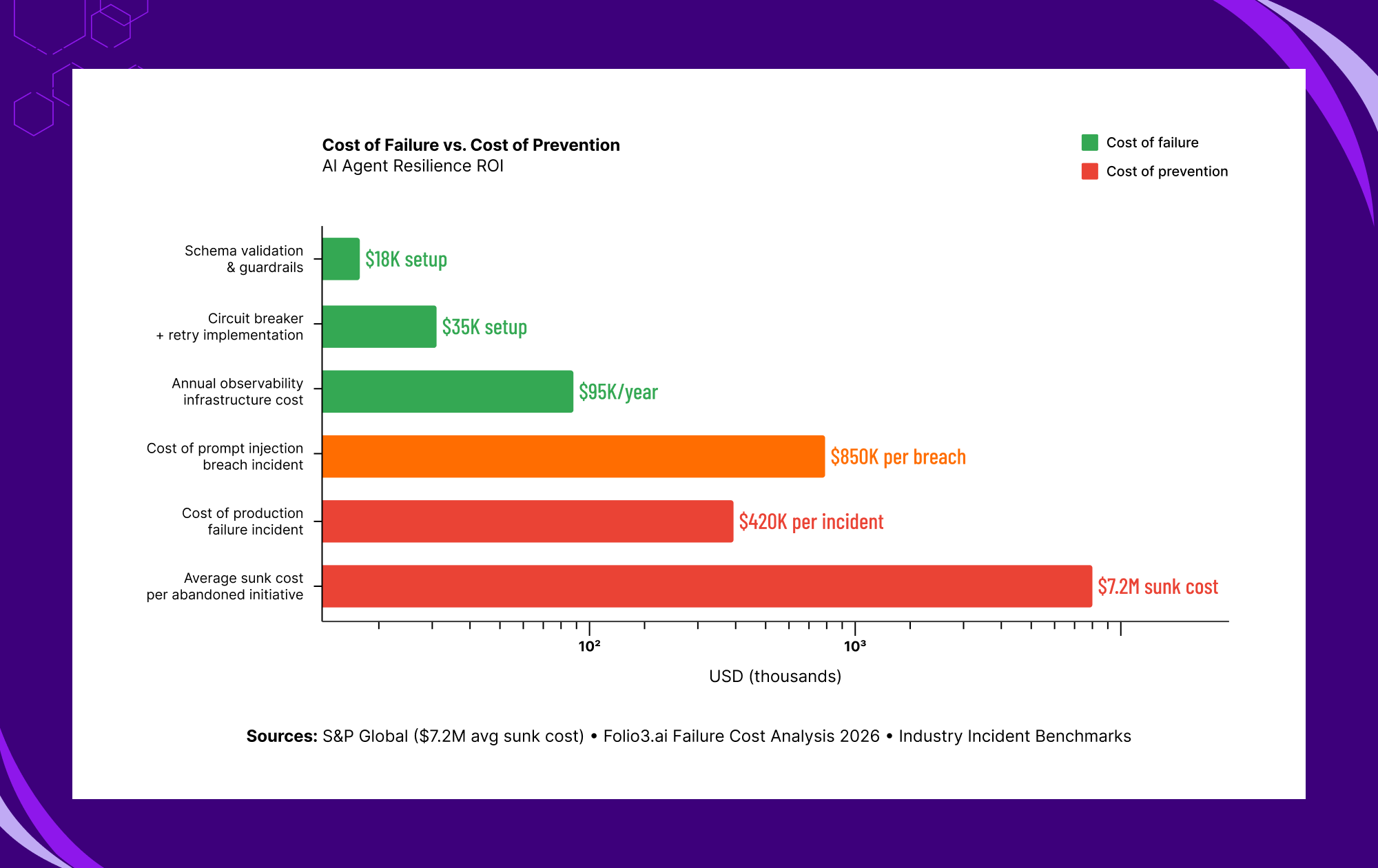
AI Agent Risk Economics Shows Sharp Gap Between Prevention and Failure Costs
The comparison between prevention and failure costs shows a sharp imbalance in AI agent risk economics. Preventive measures such as schema validation and guardrails cost only $18K, circuit breaker and retry systems cost $35K, and ongoing observability infrastructure costs about $95K per year.
In contrast, failure events are far more expensive, with prompt injection breaches costing up to $850K per incident, production failures averaging $420K each, and abandoned AI initiatives resulting in an average sunk cost of $7.2 million.
| Category | Type | Cost |
| Schema validation & guardrails | Prevention | $18K setup |
| Circuit breaker + retry implementation | Prevention | $35K setup |
| Annual observability infrastructure | Prevention | $95K/year |
| Prompt injection breach incident | Failure | $850K per breach |
| Production failure incident | Failure | $420K per incident |
| Average sunk cost per abandoned initiative | Failure | $7.2M sunk cost |
Source: Trantor
Wrapping Up
AI agent failure rates show that even though AI is improving quickly, it is still not very reliable in real-world use. Many problems are not caused by the AI models themselves, but by issues like poor data, unclear goals, weak system design, and difficulty handling long, multi-step tasks. As more companies start using AI agents, fixing these problems will be important to reduce failures and improve results.
In the future, AI agents can become much more useful if businesses improve testing, monitoring, and how these systems are built and connected to real workflows. If these improvements are made, AI agents could become reliable tools in everyday business. But if these issues are not solved, many AI projects will continue to struggle and fail to move beyond testing or deliver consistent value in real use.