
Artificial intelligence is quickly transforming the global job market by changing how work is performed, the types of jobs available, and the skills required to stay competitive. It is estimated that AI could affect around 23% of jobs worldwide, with millions of roles being both created and displaced at the same time.
While approximately 83 million jobs may be eliminated due to automation, about 69 million new jobs are also expected to be created, highlighting a significant shift rather than simple job loss. At the same time, AI is improving productivity and increasing demand for digital and technical skills. As a result, workers will need to continuously learn new skills and reskill to adapt to emerging roles in an AI-driven economy.
In this article, we are going to explore AI Workforce Impact Statistics along with key insights into job displacement, job creation, skill changes, automation trends, and the future impact of artificial intelligence on the global workforce.
Key Stats Summary: AI Workforce Impact Statistics
- 23% of global jobs are expected to be affected by structural changes in the workforce.
- Around 83 million jobs may be displaced worldwide.
- About 69 million new jobs are expected to be created.
- This results in a net loss of roughly 14 million jobs (around 2% of global employment).
- Up to 6% to 7% of jobs in the U.S. could be displaced by AI over the next decade.
- As many as 300 million jobs globally are considered at risk of automation.
- Approximately 25% of work tasks worldwide could be automated by AI.
- Only about 12% to 15% of jobs can be fully automated.
- Around 76% of entry-level roles show exposure to AI across industries.
- Up to 30% of working hours could be automated by 2030.
- More than 216,000 construction jobs have been added due to AI data center expansion since 2022.
AI Workforce Impact on Job Displacement and Creation
83 Million Jobs at Risk as Global Economy Reshapes Workforce Structure
The global job market is expected to change a lot in the coming years. About 23% of current jobs may be affected due to factors like artificial intelligence, the shift to greener energy, and wider economic changes.
In total, around 83 million jobs are expected to disappear worldwide, while about 69 million new jobs may be created at the same time. This leads to a net loss of roughly 14 million jobs, which is about 2% of total global employment.
| Indicator | Value |
| Expected Structural Job Churn | 23% of global jobs |
| Jobs Eliminated | 83 million |
| Jobs Created | 69 million |
| Net Change in Jobs | ~14 million job lost |
| Net Impact on Employment | ~2% of current global employment |
Even though the overall loss is relatively small compared to the total workforce, it shows a major reshaping of jobs, where many roles are being replaced while new ones are also being created at the same time.
AI Expected to Disrupt Up to 7% of U.S. Jobs in the Next 10 Years
According to Goldman Sachs, generative AI could replace about 6% to 7% of workers in the United States over the next 10 years. In the short term, AI has already slowed job growth by around 16,000 net jobs per month.
However, experts believe this impact will not last forever. Over time, AI is expected to improve overall productivity in the U.S. economy by about 1.5% each year, as businesses become more efficient and new types of work are created alongside automation.
Up to 300 Million Jobs at Risk from AI Automation
Research from Goldman Sachs suggests that artificial intelligence could put up to 300 million full-time jobs worldwide at risk of automation. This means that roughly one-fourth of all current work tasks could potentially be automated by AI.
However, the study also highlights that AI is not expected to fully replace most jobs. Instead, it is likely to change how many roles are performed by handling routine tasks while still supporting and working alongside human employees.
25% of Global Work Time Could Be Taken Over by AI Automation
Research shows that artificial intelligence could handle about 25% of all working hours around the world in the coming years. This means that AI may do around one-fourth of the tasks people currently spend time on at work.
Jobs that involve repetitive or simple tasks are likely to be affected the most. However, this does not always mean jobs will disappear. Instead, many jobs may change, with AI doing routine work while people focus more on important decisions, creative tasks, and problem-solving.
| Occupation | Share of Jobs Exposed to AI Automation (%) |
| Office and administrative support | 46% |
| Legal | 44% |
| Architecture and engineering | 37% |
| Life, physical, and social science | 36% |
| Business and financial operations | 35% |
| Community and social service | 33% |
| Management | 32% |
| Sales and related | 31% |
| Computer and mathematical | 29% |
| Farming, fishing, and forestry | 28% |
| Protective service | 28% |
| Educational instruction and library | 27% |
| Healthcare support | 26% |
| Arts, design, entertainment, sports, and media | 26% |
| All occupations (average) | 25% |
| Personal care and service | 19% |
| Food preparation and serving | 12% |
| Transportation and material moving | 11% |
| Production | 9% |
| Construction and extraction | 6% |
| Installation, maintenance, and repair | 4% |
| Building and grounds cleaning and maintenance | 1% |
Only 12% to 15% of Jobs Can Be Fully Automated
Estimates indicate that just 12% to 15% of jobs can be fully automated, meaning they could be entirely replaced by machines or artificial intelligence. This shows that most occupations are unlikely to disappear completely.
Instead, the majority of jobs are expected to be reshaped, with AI taking over routine tasks while humans focus on more complex, creative, and decision-making responsibilities.
Services Sector Leads in Entry-Level AI Exposure at 84% Amid Workforce Transformation
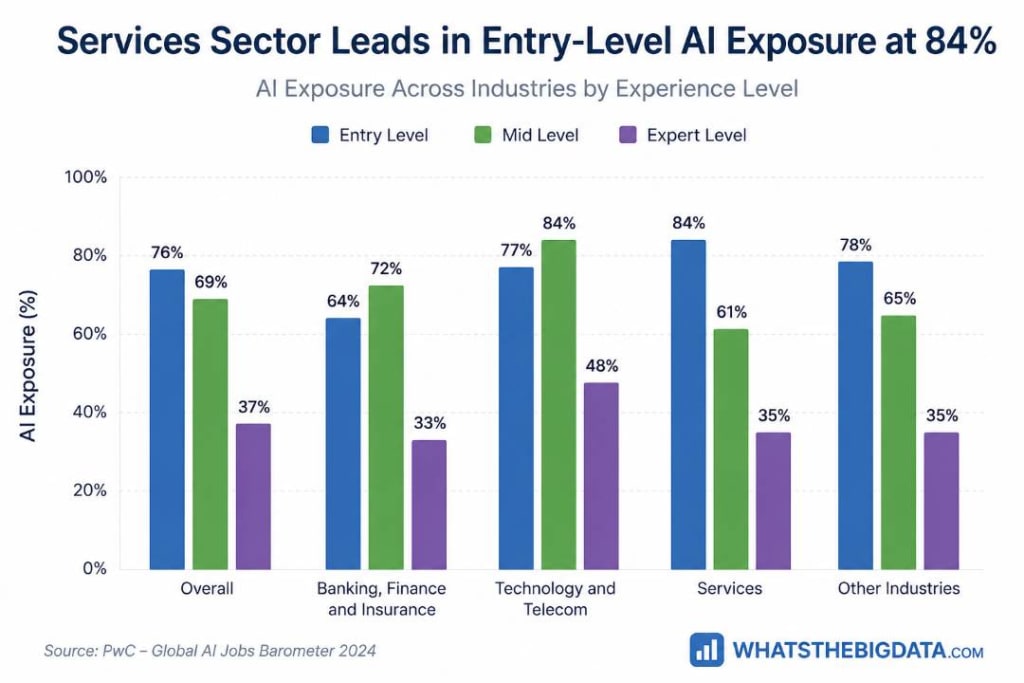
The impact of generative AI on job levels varies significantly across industries, with entry-level roles experiencing the highest exposure overall at 76%, followed by mid-level roles at 69%, while expert-level positions are comparatively less affected at 37%.
Among industries, Services shows the highest impact on entry-level jobs at 84%, though its mid-level exposure drops to 61% and expert-level to 35%. Technology and Telecom stands out for strong disruption across all tiers, particularly at the mid-level where it reaches 84%, along with 77% at entry level and 48% at expert level.
| Industry | Entry Level | Mid Level | Expert Level |
| Overall | 76% | 69% | 37% |
| Banking, Finance and Insurance | 64% | 72% | 33% |
| Technology and Telecom | 77% | 84% | 48% |
| Services | 84% | 61% | 35% |
| Other Industries | 78% | 65% | 35% |
Banking, Finance, and Insurance shows a more balanced pattern, with 64% at entry level and 72% at mid-level, but a lower 33% at expert level. Other industries also show consistently high entry-level impact at 78%, with moderate mid-level (65%) and expert-level (35%) effects.
AI Driven Workplace Automation and Change
Up to 30% of Working Hours Could Be Automated by 2030
Europe and the United States are seeing big changes in job demand because labor markets are tightening, productivity growth is slowing, and artificial intelligence and automation are becoming more widely used. By 2030, it is estimated that up to 30% of working hours could be automated in a moderate adoption scenario, mainly due to advances in generative AI.
The demand for workers in STEM fields, healthcare, and other skilled professions is expected to grow, while jobs in office support, manufacturing, and customer service are likely to decrease. Other major changes such as the shift to net-zero emissions, an aging population, the rise of e-commerce, and increased investment in infrastructure and technology are also reshaping the job market and changing how employment is distributed across different sectors.
AI Infrastructure Boom Adds 216,000 Data Center Construction Jobs Since 2022

Since October 2022, employment trends have already started shifting due to rising investment in AI infrastructure, particularly data centers. Jobs linked to data center construction have increased significantly, with about 216,000 new construction roles added in this area.
This growth is much faster than the broader economy, which has grown by only 3.66% in the same period. Within construction-related sectors, utilities construction saw an 11.7% increase, followed by electrical contractors at 7.96%, HVAC contractors at 7.93%, and commercial contractors at 7.42%. Even construction excluding data centers grew by a lower 3.7%, showing how strongly AI-driven infrastructure demand is influencing hiring patterns.
| Job Type | Change Percentage |
| Utilities Construction | 11.7% |
| Electrical Contractors | 7.96% |
| HVAC Contractors | 7.93% |
| Commercial Contractors | 7.42% |
| Construction ex-data centers | 3.7% |
| Overall Economy | 3.66% |
Workforce Skills Under Pressure as 44% Face Disruption in the Next 5 Years
Recent workforce studies indicate that skill requirements are changing rapidly due to automation, artificial intelligence, and digital transformation. Around 44% of workers’ skills are expected to be disrupted within the next five years, meaning nearly half of today’s job-related skills will either become outdated or need significant updating.
80% of Workers to Have at Least 10% of Tasks Influenced by AI Tools
Workplace studies indicate that artificial intelligence is increasingly becoming embedded in everyday job functions across sectors. Around 80% of workers are expected to see at least 10% of their tasks influenced by AI tools, indicating that automation and AI assistance will become a common part of routine work.
This does not necessarily mean job loss, but rather a shift in how work is performed, with AI handling repetitive or time-consuming tasks while employees focus more on analysis, decision-making, and creative responsibilities.
AI and Robotics Projected to Handle Half of Workplace Functions by 2040
Forecasts on the future of work suggest a major redistribution of responsibilities between humans and machines over the coming decades. By 2040, roughly 50% of workplace tasks in some industries may be shared or shifted between human workers and automated systems.
This reflects the growing role of artificial intelligence, robotics, and advanced software in performing both routine and complex activities. Rather than fully replacing jobs, this transition is expected to reorganize how tasks are completed, with machines handling data-heavy and repetitive functions while humans focus on judgment, creativity, and interpersonal roles.
1 in 4 Job Tasks Now Exposed to Generative AI Automation
Studies on automation potential show that generative AI is already capable of handling a notable share of work activities. Nearly 25% of existing tasks can currently be automated using generative AI tools, reflecting how far this technology has progressed in performing routine and information-based work.
AI Workforce Impact on Skills and Reskilling Demand
AI Driven Shift Could Force 375 Million Workers Into New Occupations by 2030
By 2030, artificial intelligence is expected to significantly reshape global labor markets, with estimates suggesting that around 375 million workers may need to transition into new occupations due to AI-driven change.
This shift reflects the increasing automation of routine and repetitive tasks, as well as the growing demand for skills in areas such as data analysis, AI system management, and digital services. As industries adopt advanced technologies at scale, many existing job roles are likely to be redefined or replaced, requiring workers to reskill or upskill to remain competitive.
44% of Workers Expected to Need Reskilling Within the Next Five Years
Nearly 44% of workers are expected to require reskilling within the next five years, highlighting the accelerating pace of change in today’s labor market. This reflects how quickly job roles are evolving due to advances in automation, artificial intelligence, and digital transformation across industries.
As new technologies reshape workflows, many existing skills are becoming outdated, creating an urgent need for employees to adapt to new tools, systems, and ways of working. The demand for reskilling is particularly strong in sectors undergoing rapid technological integration, where employees must continuously update their competencies to remain effective.
AI Related Skill Demand Increases 7x as Job Market Rapidly Shifts
Demand for AI-related skills has increased seven times in just two years, showing how quickly the importance of artificial intelligence is growing in the job market. This sharp rise reflects the rapid adoption of AI tools and technologies across industries such as healthcare, finance, education, and technology. As companies integrate AI into their daily operations, they are actively looking for workers who understand how to use, manage, and develop these systems.
56% Annual Increase in AI Skill Demand Reshapes Job Requirements
AI-related skill requirements in jobs have increased by 56% year over year, indicating a rapid shift in how work is being defined and performed. This steady rise shows that employers are updating job roles much more frequently as artificial intelligence becomes more integrated into everyday business operations.
Many tasks are being redesigned with AI support, which is changing the type of skills employees need to stay effective. As a result, workers are expected to adapt more quickly and continuously upgrade their knowledge, especially in digital and AI-based tools.
AI Skilled Workers Earn Up to 56% More Than Non AI Peers
Workers who have AI skills can earn up to 56% more than those in similar jobs without these skills. This shows that AI knowledge is becoming very valuable in the job market. Companies are willing to pay higher salaries to people who can use AI tools, work with data, and help improve automated systems.
As more businesses start using AI in their daily work, the demand for skilled workers is increasing quickly. Because of this, having AI skills can lead to better pay and more job opportunities in many industries, especially in technology and business-related fields.
AI Workforce Impact on Productivity & Economic Effects
AI Could Boost Global Productivity by 0.8% to 1.4% Annually
Artificial intelligence could increase global productivity by about 0.8% to 1.4% every year. This means people and businesses around the world may be able to produce more output using the same time and resources.
AI helps by handling repetitive tasks, making work faster, and supporting better decision-making. As more companies start using AI in different industries, work processes become more efficient and less time-consuming. Even a small yearly increase in productivity can lead to big improvements in economic growth over time.
AI Boosts Knowledge Worker Productivity by 20% to 40%
Knowledge workers who use AI report productivity gains of around 20% to 40%, showing a clear boost in how efficiently they complete their tasks.
This improvement comes from AI tools helping with activities like writing, research, data analysis, and routine documentation, which allows employees to focus more on higher-value work. By reducing the time spent on repetitive or time-consuming tasks, AI enables workers to produce better results in less time.
Artificial Intelligence Boosts Productivity and Revenue Efficiency in Firms
Companies that use artificial intelligence tend to show higher revenue growth per employee compared to those that do not. This indicates that AI is helping businesses become more efficient by enabling workers to produce more value within the same amount of time.
By automating routine tasks and improving decision-making through data analysis, AI allows employees to focus on higher-impact work that directly contributes to revenue generation. As a result, organizations that adopt AI tools are often able to scale productivity without a proportional increase in workforce size.
Over 80% of AI Using Organizations Report Improved Efficiency
Over 80% of organizations that use artificial intelligence report clear improvements in efficiency, showing how widely AI is helping businesses work better. This means most companies using AI are able to complete tasks faster, reduce manual effort, and improve overall productivity.
AI tools help automate routine work, support decision-making, and make business processes more organized and effective. As a result, employees can focus more on important tasks instead of spending time on repetitive activities.
AI Workplace Adoption and Hiring Trends
AI Adoption Reaches 70% to 90% Across Global Organizations
Around 70% to 90% of companies are now using artificial intelligence in at least one part of their business, showing how quickly AI has become a common tool across industries. This means most organizations are already applying AI in areas like customer service, marketing, operations, or data analysis to improve efficiency and decision-making.
The wide adoption reflects how AI is no longer limited to large tech firms but is being used by businesses of all sizes. As more companies integrate AI into their workflows, it is becoming a key part of how modern organizations operate and compete in the market.
32% of Businesses Forecast Job Reductions Linked to AI Adoption
Nearly 32% of organizations expect that artificial intelligence will lead to workforce reductions in the future, showing that many companies anticipate changes in staffing needs as automation increases.
This means that about one in three businesses believes AI could replace or reduce certain roles, especially those involving repetitive or routine tasks. As AI systems become more capable, organizations are looking at ways to improve efficiency, which may reduce the need for some human labor in specific functions.
1 in 8 Companies Forecasts Job Creation From Artificial Intelligence
Around 13% of companies expect to hire more workers because of the growth of artificial intelligence. This shows that AI is not only replacing some tasks but also creating new job opportunities.
As businesses use more AI tools, they need people to build, manage, and maintain these systems. They also need workers with skills in areas like data, technology, and cybersecurity. So, while some jobs may change or decrease, AI is also helping create new roles and increasing demand for skilled employees in certain fields.
AI Drives Decline in Clerical Hiring as Routine Office Tasks Are Automated
Many companies are hiring fewer people for clerical jobs because of artificial intelligence. This is because AI can now handle many simple office tasks like data entry, scheduling, and basic record keeping.
As a result, businesses are using machines and software instead of doing these tasks manually. This reduces the need for workers in routine office roles. In addition, companies are changing some jobs to include more use of digital tools and AI systems.
Wrapping Up
AI Workforce Impact Statistics clearly show that artificial intelligence will continue to reshape the global job market in the coming years. While some jobs and tasks will be automated, many new roles will also be created, leading to a major shift rather than a total loss of employment.
The future workforce will be more focused on digital skills, problem-solving, creativity, and working alongside AI tools. As automation expands across industries, continuous learning and reskilling will become essential for workers to stay relevant. Overall, the future outlook suggests a more flexible and technology-driven job market where AI supports human work, improves productivity, and transforms how businesses operate worldwide.
Source and references:
https://www.goldmansachs.com/insights/articles/how-will-ai-affect-the-us-labor-market
https://initiatives.weforum.org/reskilling-revolution/skills-initiatives
https://www.mckinsey.com/mgi/our-research/a-new-future-of-work-the-race-to-deploy-ai-and-raise-skills-in-europe-and-beyond
https://www.pwc.com/id/en/media-centre/press-release/2025/english/ai-linked-to-fourfold-productivity-growth-and-56-percent-wage-premium-jobs-grow-despite-automation-pwc-2025-global-ai-jobs-barometer.html
